 soofha
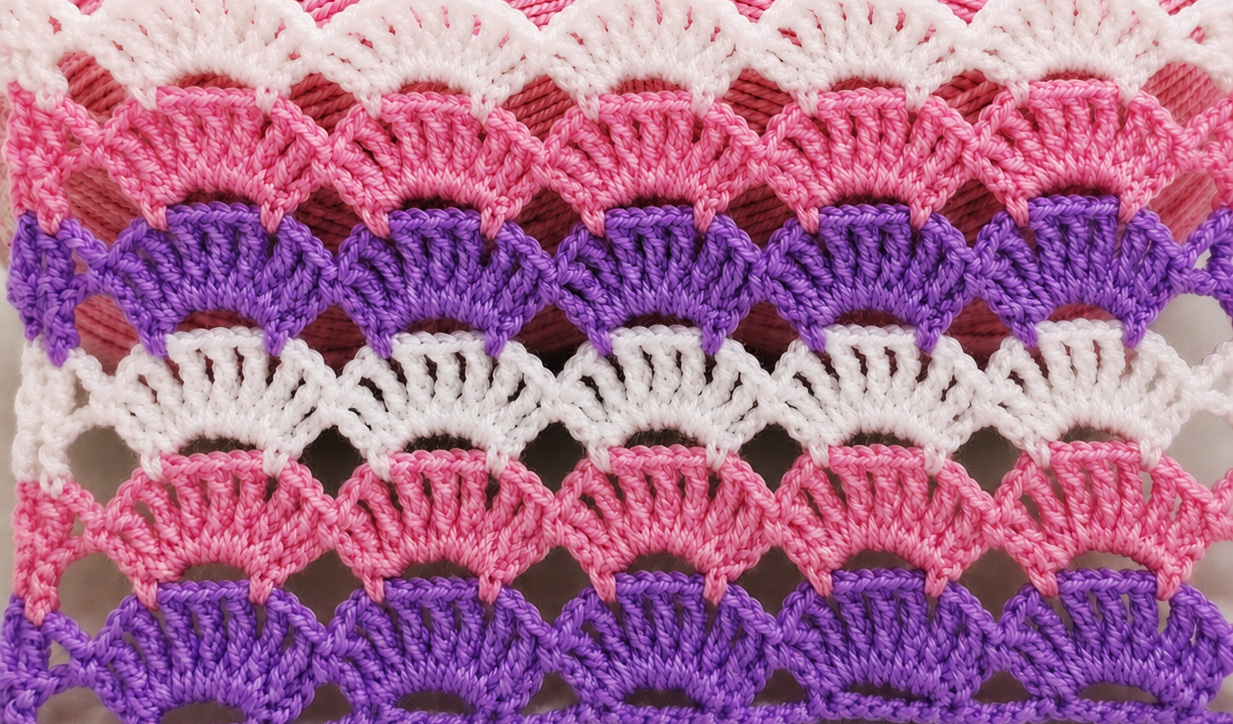
Few crochet stitches manage to look both delicate and luxurious while remaining beginner-friendly. The Shell Stitch is one of them. With its soft scalloped texture and flowing pattern, it has become a favorite in everything from baby blankets to elegant shawls and decorative home pieces.
At first glance, Shell Stitch may appear intricate, almost as if it belongs only in advanced-level projects. In reality, the technique is surprisingly approachable. Once the rhythm clicks, the pattern becomes relaxing and repetitive in the best possible way. That balance between simplicity and sophistication is exactly why Shell Stitch continues to appear in some of the most popular Crochet Patterns available today.
Whether you’re creating handmade gifts, building a small crochet business, or simply looking for a stitch that feels rewarding to work on, Shell Stitch deserves a place in your toolkit.
What Is the Shell Stitch in Crochet?
Shell Stitch is a decorative crochet technique made by working multiple stitches into the same space, usually double crochets. This creates a fan or shell-like shape that repeats across the fabric.
The classic version often uses five double crochets worked into one stitch or chain space, though variations exist depending on the design.
The finished texture has a soft wave effect that instantly makes a project look more detailed and elegant.
You’ll commonly see Shell Stitch used in:
- Baby blankets
- Shawls and wraps
- Summer tops
- Pillow covers
- Table runners
- Crochet bags
- Decorative borders
Its versatility is one reason it remains a staple in both premium and Free Crochet Patterns online.
Why Shell Stitch Is Perfect for Beginners
Many beginners avoid textured stitches because they assume complicated patterns require advanced skills. Shell Stitch proves otherwise.
Although the result looks impressive, the technique itself relies mostly on basic crochet stitches repeated in a simple sequence.
Here’s why beginners love it:
- Easy to memorize after a few rows
- Works up quickly
- Creates visually impressive results
- Helps improve stitch consistency
- Builds confidence with pattern reading
For someone transitioning from single crochet and double crochet into more decorative work, Shell Stitch feels like a natural next step.
Materials You’ll Need
The beauty of this stitch changes dramatically depending on the yarn and hook you choose. A thoughtful combination can make the shells look crisp, airy, or soft and cozy.
Best Yarn Types for Shell Stitch
Cotton Yarn
Cotton gives excellent stitch definition, making every shell clearly visible. It’s ideal for table décor, bags, and summer garments.
Acrylic Yarn
Soft acrylic yarn works beautifully for blankets and scarves. It’s affordable, easy to wash, and beginner-friendly.
Blended Fibers
Cotton-acrylic blends offer the best of both worlds: structure and softness.
Choosing the Right Hook Size
Most Shell Stitch projects work well with medium-sized hooks.
| Yarn Weight | Recommended Hook |
|---|---|
| Lightweight yarn | 3 mm – 4 mm |
| Medium yarn | 4 mm – 5.5 mm |
| Bulky yarn | 6 mm and above |
If you want the shells to appear more open and lace-like, try using a slightly larger hook than recommended on the yarn label.
How to Crochet the Basic Shell Stitch
There are many variations of Shell Stitch, but the traditional version is the easiest place to start.
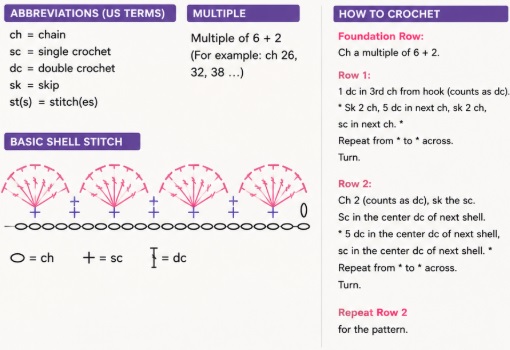
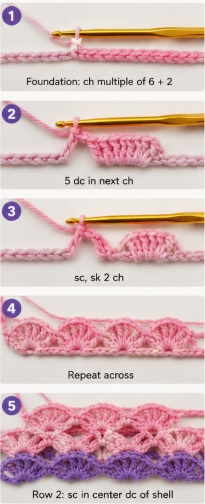
Step 1: Create the Foundation Chain
Begin with a chain count divisible by six, then add two extra chains.
Example:
24 + 2 chains.
This setup helps maintain even spacing between shell repeats.
Step 2: Work the First Shell
A standard shell often consists of:
- 5 double crochets in one stitch
- Skip 2 stitches
- 1 single crochet
- Skip 2 stitches
- Repeat
That repeating sequence creates the scalloped effect.
Step 3: Build the Next Row
In the following row:
- Work a single crochet into the center of the shell below
- Create a new shell in the next chain space
After only a few rows, the flowing pattern becomes clearly visible.
Tips for Making Your Shell Stitch Look Professional
Maintain Even Tension
Uneven tension is one of the fastest ways to ruin the graceful appearance of Shell Stitch.
If some shells are tight while others are loose, the edges may ripple inconsistently.
A good habit is to pause every few rows and lay the piece flat to check its shape.
Avoid Fuzzy Yarn at First
Textured or fluffy yarn hides stitch definition, making it harder to identify where each shell begins and ends.
For practice projects, smooth cotton or acrylic yarn in light colors works best.
Use Stitch Markers
This becomes especially helpful on large projects like blankets.
Markers make it easier to identify row beginnings and avoid accidental stitch increases.
Best Projects for Shell Stitch Crochet Patterns
Baby Blankets
Shell Stitch creates a soft, cozy texture perfect for baby blankets.
Pastel shades like pink, lavender, cream, and soft gray enhance the delicate scalloped design beautifully.
Many handmade baby blankets sold online rely on Shell Stitch because it looks detailed without requiring overly complicated construction.
Lightweight Shawls
Because the stitch naturally creates small open spaces, it works wonderfully for breathable shawls and wraps.
Gradient yarn cakes are especially beautiful with Shell Stitch because the color transitions highlight the waves in the fabric.
Crochet Bags
Using sturdy cotton yarn transforms Shell Stitch into an eye-catching texture for handbags and tote bags.
Adding a fabric lining inside the bag helps maintain structure while preventing stretching.
Decorative Borders
Even if you don’t want to use Shell Stitch for an entire project, it works beautifully as an edging detail.
Many crocheters add shell borders to:
- Towels
- Cardigans
- Pillowcases
- Dresses
- Baby clothing
A simple border can completely elevate an otherwise plain design.
Common Mistakes and How to Avoid Them
Accidentally Adding Stitches
This is one of the most common beginner mistakes.
If extra stitches sneak into the pattern, the project may gradually widen or lose its shape.
Instead of counting every stitch individually, count the number of shells at the end of each row.
Forgetting the Single Crochet Between Shells
The single crochet creates separation and structure.
Without it, the shells blend together and lose their defined shape.
Using a Hook That’s Too Small
Tight stitches flatten the shells and remove the airy texture that makes this pattern attractive.
If your fabric feels stiff, sizing up your hook slightly usually helps.
Choosing Colors for Shell Stitch Projects
Color selection makes a huge difference with textured stitches.
Some combinations that work especially well include:
- White and blush pink
- Lavender and cream
- Beige and mocha
- Sage green and ivory
- Ombre gradients
Shell Stitch naturally creates visual movement, so overly busy color palettes can sometimes overwhelm the design.
Two or three complementary colors usually produce the cleanest results.
Can You Sell Items Made with Shell Stitch?
Absolutely. In fact, many successful handmade crochet shops use Shell Stitch regularly because customers often associate it with luxury craftsmanship.
Some profitable handmade items include:
- Baby blankets
- Beach bags
- Decorative cushion covers
- Women’s shawls
- Table runners
Careful finishing, neat edges, and modern color palettes can significantly increase the perceived value of your work.
Shell Stitch vs. Fan Stitch
These two stitches are frequently confused because they share a similar appearance.
Shell Stitch
Usually denser and more structured, with defined spacing between motifs.
Fan Stitch
Typically more open and airy, often used in lace-style projects.
Some designers even use the names interchangeably, depending on the pattern style.
Where to Find Reliable Free Crochet Patterns
The internet is filled with crochet tutorials, but not all patterns are written clearly.
Reliable Free Crochet Patterns usually include:
- Step-by-step photos
- Stitch counts
- Clear abbreviations
- Video support
- User reviews or finished project examples
Patterns from experienced crochet designers are generally easier to follow than random social media posts with incomplete instructions.
How to Improve Your Crochet Pattern Skills
Learning crochet isn’t only about memorizing stitches. The real growth happens when you begin understanding how patterns are constructed.
Try experimenting with:
- Different shell sizes
- Alternate spacing
- Mixed stitch textures
- Color transitions
- Border variations
Over time, you’ll start adapting existing Crochet Patterns into your own unique designs.
That’s often the moment crochet shifts from being a hobby to becoming true creative expression.
FAQ
Is Shell Stitch suitable for complete beginners?
Yes. While it looks advanced, it mainly uses simple stitches repeated in a pattern.
What yarn works best for Shell Stitch?
Cotton yarn provides excellent stitch definition, while acrylic yarn creates a softer texture for blankets and clothing.
Why does my project keep curving?
This usually happens because of uneven tension or accidentally adding stitches between shells.
Can Shell Stitch be used for clothing?
Definitely. It’s especially popular in shawls, summer tops, and decorative garment edges.
How long does it take to learn Shell Stitch?
Most beginners can understand the basic repeat within an hour or two of practice.
Are Free Crochet Patterns reliable?
Many are excellent, especially those from established crochet blogs and experienced pattern designers. Always look for clear instructions and user feedback before starting a project.

