 soofha
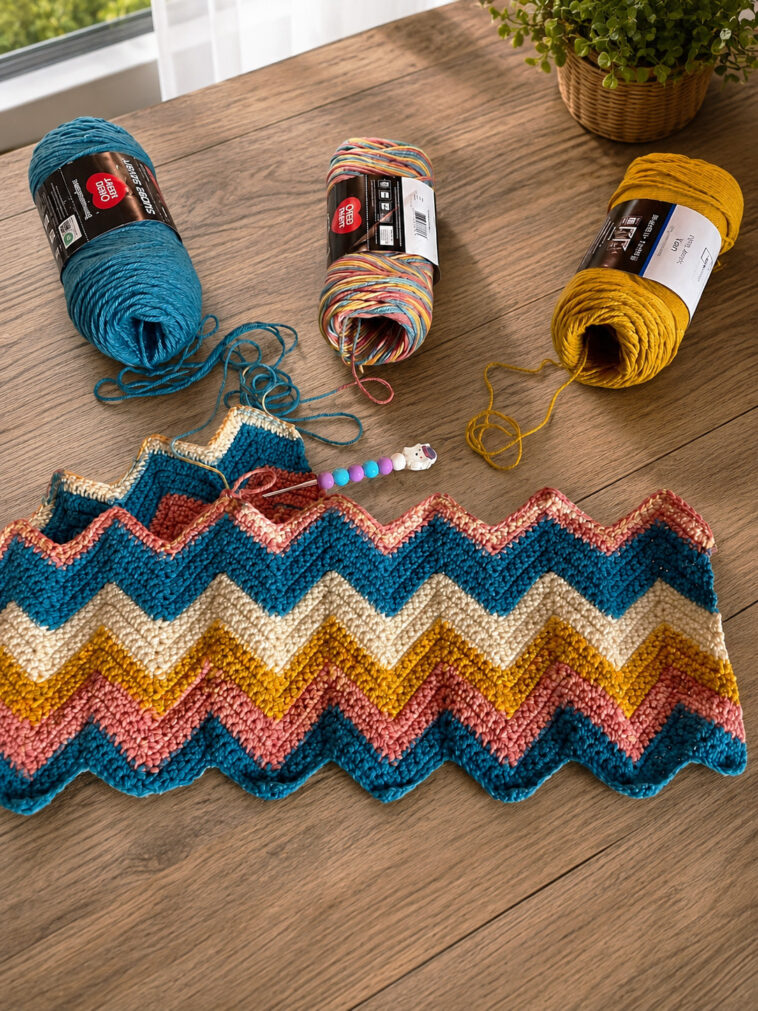
The Crochet Chevron Blanket is a timeless project that brings together bold zigzag waves, colorful stripes, and a wonderfully cozy handmade texture. The repeating peaks and valleys create a beautiful ripple effect that makes even simple stitches look impressive.
This blanket is a great project for crocheters who already know the basic stitches and want to practice increases and decreases while creating something practical for the home. Chevron designs work particularly well with multiple colors because every stripe highlights the movement of the zigzag pattern.
The blanket shown above uses a cheerful combination of teal blue, cream, mustard yellow, and dusty pink, with narrow contrasting details that make the waves stand out beautifully.
Pattern note: The written instructions below are an original, easy-to-follow chevron variation inspired by the classic peak-and-valley construction visible in the sample. Adjust your starting chain and stripe sequence to create your preferred blanket size.
What Is a Crochet Chevron Stitch?
A crochet chevron, sometimes called a ripple stitch, creates a repeating series of peaks and valleys. The peaks are formed by working extra stitches into one stitch, while the valleys are created with decreases. This combination causes the fabric to move upward and downward in a regular zigzag pattern.
Chevron blankets can be made with single crochet, half double crochet, or double crochet. The version below uses single crochet, making it a relatively simple project once you understand where the increases and decreases are placed.
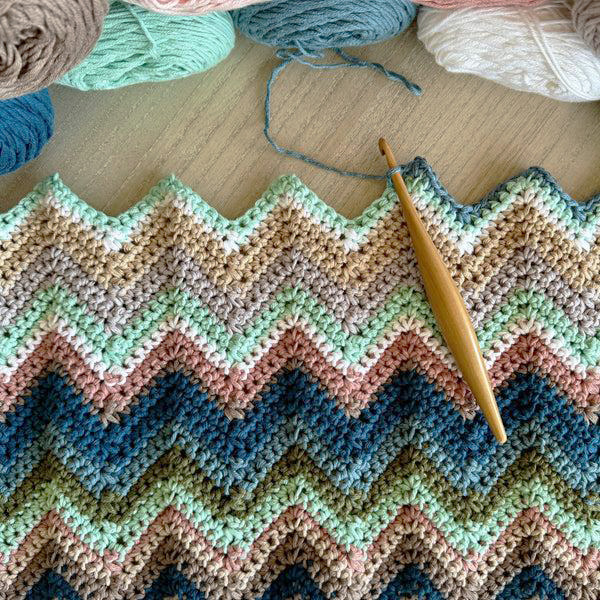
Crochet Chevron Blanket Free Pattern
Skill Level
Easy to Intermediate
You should be comfortable with:
- Chain stitch
- Single crochet
- Single crochet two together
- Working multiple stitches into one stitch
- Changing colors
- Weaving in ends
Crochet Terms
This pattern uses US crochet terminology.
- ch – chain
- sc – single crochet
- sc2tog – single crochet 2 together
- st/sts – stitch/stitches
- rep – repeat
- sk – skip
- sl st – slip stitch
Materials
For a blanket similar to the one pictured, you will need:
- Medium-weight yarn, approximately 4 worsted
- 4–6 coordinating colors
- Crochet hook appropriate for your yarn
- Yarn needle
- Scissors
- Stitch markers, optional
For the pictured color inspiration, try:
- Deep teal
- Dusty rose
- Mustard yellow
- Warm cream
- Multicolor or variegated yarn for an accent stripe
The exact amount of yarn will depend on your finished blanket dimensions, yarn weight, hook size, and personal tension.
Choosing Your Blanket Size
One of the best things about a chevron blanket is how easy it is to resize.
Begin with a foundation chain that follows the pattern repeat:
Multiple of 12 + 2
For example:
- 62 chains = small throw
- 74 chains = larger throw
- 86 chains = lap blanket
- 98 chains = wider blanket
You can continue increasing the foundation chain by 12 stitches to make the blanket wider.
Always make sure your foundation chain is loose enough that it doesn’t pull the bottom edge of the blanket inward.
Crochet Chevron Blanket Instructions
Foundation Chain
Chain a multiple of 12 + 2.
For a small sample, you could begin with:
ch 62
Row 1
Work 2 sc into the 2nd chain from the hook.
Sc in each of the next 4 chains.
Sc2tog over the next 2 chains.
Sc2tog over the next 2 chains.
Sc in each of the next 4 chains.
Work 2 sc into the next chain.
Repeat this sequence across the foundation chain:
2 sc in next stitch, sc in next 4, sc2tog twice, sc in next 4, 2 sc in next stitch.
Continue until you reach the end of the row.
Chain 1 and turn.
Row 2
Work 2 sc in the first stitch.
Sc in each of the next 4 stitches.
Sc2tog twice.
Sc in each of the next 4 stitches.
Work 2 sc in the next stitch.
Repeat the same sequence across the row.
Chain 1 and turn.
Rows 3 and Beyond
Repeat Row 2 until your blanket reaches the desired length.
That’s it!
The increases create the peaks, while the decreases form the valleys. Keeping these stitch groups consistent is what gives the blanket its characteristic zigzag shape.
How to Change Colors
Color changes are one of the most exciting parts of making a chevron blanket.
For a design similar to the pictured blanket, you can work several rows in each color.
For example:
Rows 1–4: Teal
Rows 5–8: Cream
Rows 9–12: Mustard
Rows 13–16: Dusty pink
Rows 17–20: Teal
Rows 21–24: Cream
Continue repeating your color arrangement until the blanket reaches the length you want.
You don’t have to use equal-width stripes. Try alternating:
- 2 rows of one color
- 4 rows of another
- 6 rows of a main color
- 1-row accent stripes
Thin accent stripes can make the chevron peaks especially noticeable.
How to Keep Your Chevron Edges Straight
Chevron blankets can sometimes develop uneven edges if the first or last stitches are missed.
Here are a few helpful tips:
1. Count your stitches
After each row, make sure your stitch count remains consistent.
2. Mark the peaks
Place a stitch marker in the center stitch of each peak when you’re learning the pattern. This makes it easier to recognize where your increases belong.
3. Identify the valleys
The two decreases in each section create the bottom of the V. If your blanket begins looking uneven, check that you’re placing the decreases in the correct stitches.
4. Don’t crochet too tightly
A tight foundation chain can cause the bottom edge to pull inward. Make your beginning chain slightly looser than your regular stitches.
5. Check your first few rows
Don’t wait until you’ve crocheted 20 rows to discover a mistake. Spread your work flat every few rows and check that the peaks and valleys line up.
Creating a Beautiful Color Palette
The chevron pattern is perfect for experimenting with color.
For a look similar to the blanket pictured, use a combination of deep teal, mustard, cream, and dusty pink.
Another beautiful combination would be:
- Navy
- Light blue
- White
- Soft gray
- Blush pink
For a modern neutral blanket, try:
- Cream
- Beige
- Taupe
- Charcoal
- Warm brown
Or create a cheerful rainbow version using one color for each stripe.
A variegated yarn can also be used for one of the stripes to introduce several colors without having to change yarn constantly.
Simple Border for a Chevron Blanket
A chevron blanket can look beautiful without a border, especially when the zigzag edge is part of the design.
If you want a more finished appearance, however, you can add a simple border.
Option 1: Single Crochet Border
Join your border color at one corner.
Work single crochet around the blanket, placing stitches evenly along the sides.
At each corner, work 3 sc into the corner space.
Join with a slip stitch.
Repeat for another round if desired.
Option 2: Half Double Crochet Border
For a slightly thicker finish, use half double crochet around the blanket.
Again, place 3 stitches into each corner so the border can turn smoothly.
Tips for Making a Chevron Blanket
Keep Your Tension Consistent
Chevron patterns depend on carefully balanced increases and decreases. If your tension changes dramatically from row to row, the waves may become irregular.
Use Stitch Markers
Markers can be especially helpful for identifying the peak and valley sections.
Make a Small Swatch
Before beginning a full-size blanket, crochet a small sample. This lets you check the appearance of your colors and determine whether you like the fabric’s drape.
Don’t Worry About Perfect Waves
Handmade blankets naturally have slight variations. Blocking your finished blanket can help relax the stitches and make the zigzag design look more uniform.
Crochet Chevron Blanket Video Tutorial
If you’re a visual learner, a video tutorial can make the chevron construction much easier to understand. Watching the increases and decreases being worked is particularly helpful when you’re making your first ripple blanket.
Video Tutorial:
You can also watch a public chevron tutorial demonstrating the classic construction and how the peaks and valleys are formed.
Frequently Asked Questions
Is the crochet chevron blanket difficult?
Not particularly. Once you understand where to make the increases and decreases, the pattern becomes repetitive. It is a good project for crocheters who are comfortable with basic stitches.
How many chains do I need for a chevron blanket?
For this version, begin with a multiple of 12 + 2 chains. Adding more groups of 12 makes the blanket wider.
Can I use different yarn weights?
Yes. You can make a chevron blanket with different yarn weights, but your finished size and yarn requirements will change. Use a crochet hook appropriate for the yarn you’re using.
Can I make a baby blanket with this pattern?
Absolutely. Chevron blankets make beautiful baby blankets. Choose soft yarn and a gentle color palette, and adjust the foundation chain to create a smaller size.
Can beginners make a chevron blanket?
Yes, especially after practicing single crochet and sc2tog. The most important part is learning to recognize the peaks and valleys and maintaining the correct stitch sequence.
Final Thoughts
The Crochet Chevron Blanket is one of those patterns that never really goes out of style. Its distinctive zigzag design gives a simple crochet fabric plenty of visual interest, while stripes allow you to customize the finished blanket to match almost any room.
The colorful combination in the sample—teal, cream, mustard, and dusty pink—creates a warm, cheerful look, but don’t be afraid to experiment with your own palette.
Whether you’re making a baby blanket, lap throw, sofa blanket, or full-size bedspread, the basic chevron construction makes it easy to adjust the width and length. Once you get into the rhythm of the increases and decreases, this can become a relaxing project to work on while watching your favorite show or listening to a podcast.
Save this pattern, choose your favorite yarn colors, and start crocheting your own beautiful zigzag blanket!

