 soofha
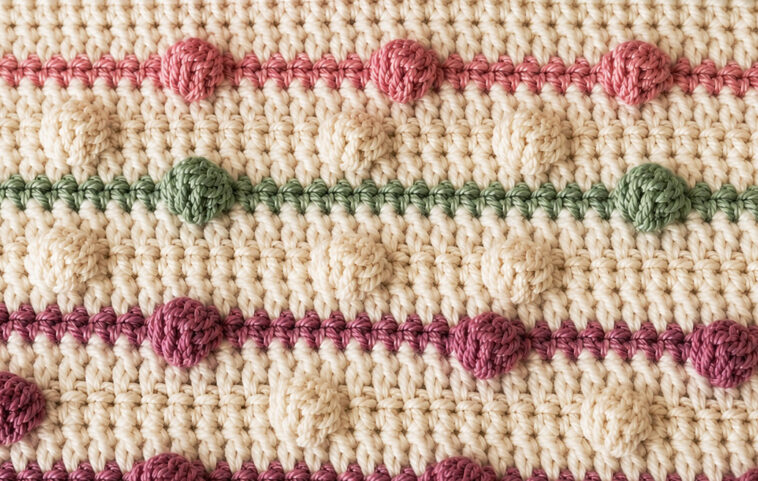
The Crochet Diagonal Bobble Stripe Stitch is a beautiful textured crochet pattern that combines a soft single-crochet background with raised bobbles arranged along diagonal lines. The result is a delicate, dimensional fabric that looks especially pretty when worked in soft neutral colors with dusty pink, rose, sage green, or other muted shades.
The stitch shown in the sample has a cozy handmade appearance, making it a wonderful choice for blankets, baby blankets, scarves, pillows, bags, table runners, and decorative home accessories.
Bobble stitches are especially effective for adding texture because they create small raised clusters that stand out from the background. Similar bobble designs can also be arranged into diagonal stripes by gradually shifting their position from one textured row to the next.
What Is the Crochet Diagonal Bobble Stripe Stitch?
This stitch is based on a simple crochet fabric with decorative bobbles positioned so they travel diagonally across the project.
The main fabric can be worked in one neutral color, while the diagonal bobble stripes are made in a contrasting color. For the look shown here, a combination such as:
- Cream or ivory
- Dusty rose
- Sage green
- Mauve
- Soft blush
creates a gentle vintage-inspired effect.
The bobbles add dimension without making the entire fabric overly bulky. Because the background is relatively simple, the textured diagonal stripes become the main feature.
Why You’ll Love This Stitch
- Beautiful raised texture
- Easy single-crochet background
- Great for color combinations
- Creates attractive diagonal movement
- Perfect for blankets and baby projects
- Uses basic crochet stitches
- Easy to customize
- Excellent for practicing bobble stitches
- Works beautifully with solid or variegated yarn
Skill Level
Easy to Intermediate
You should be comfortable with:
- Chain stitch
- Single crochet
- Slip stitch
- Basic color changes
- Bobble stitch
The bobble stitch may require a little practice at first, but once you understand how to create the raised cluster, the rest of the pattern is repetitive.
Materials
For a small sample or dishcloth:
- Worsted-weight cotton yarn
- Crochet hook appropriate for your yarn
- Scissors
- Yarn needle
For a blanket, choose a soft worsted-weight or aran yarn.
Suggested Color Palette
For a look similar to the sample:
Color A – Cream: Main background
Color B – Dusty Rose: Pink diagonal bobbles
Color C – Sage Green: Green diagonal bobbles
You can also work the entire project with only two colors.
Crochet Abbreviations
US crochet terminology:
- ch – chain
- sc – single crochet
- sl st – slip stitch
- st/sts – stitch/stitches
- yo – yarn over
- RS – right side
- WS – wrong side
- BO – bobble
How to Make the Bobble Stitch
For this pattern, you can use a simple 5-dc bobble.
5-Double-Crochet Bobble
- Yarn over and insert your hook into the indicated stitch.
- Yarn over and pull up a loop.
- Yarn over and pull through 2 loops.
- Repeat the process in the same stitch until you have five partially completed double crochets.
- You will have several loops on your hook.
- Yarn over and pull through all remaining loops.
- Push the completed bobble gently toward the front of the work.
The exact number of double crochets in a bobble can be adjusted. A 3-dc bobble gives a smaller bump, while a 5-dc bobble creates a fuller, more prominent texture. Bobble stitch instructions commonly use multiple partial double crochets worked into the same stitch and then closed together.
Crochet Diagonal Bobble Stripe Stitch Pattern
Foundation
Chain a multiple of 12 + 1.
For example:
- 37 chains
- 49 chains
- 61 chains
- 73 chains
- 85 chains
For a larger blanket, simply continue adding groups of 12 stitches.
Row 1 – Foundation
With Color A:
Ch 1.
Work 1 sc in the second chain from the hook and in every chain across.
Turn.

Row 2
Ch 1.
Sc in every stitch across.
Turn.

Row 3 – First Bobble Stripe
Join Color B.
Ch 1.
Sc in the first 4 sts.
Work 1 bobble in the next stitch.
Sc in the next 7 sts.
Work 1 bobble in the next stitch, sc in the next 7 sts.
Repeat from * across the row.
Finish with sc stitches as needed to maintain the original stitch count.
Turn.

Row 4
With Color A:
Ch 1.
Sc in every stitch across.
Turn.

Row 5 – Shift the Bobbles
Join Color B.
Ch 1.
Sc in the first 6 sts.
Work 1 bobble in the next stitch.
Sc in the next 7 sts.
Work 1 bobble in the next stitch, sc in the next 7 sts.
Repeat across.
The bobbles have now moved slightly to the side. This small movement is what begins creating the diagonal effect.
Turn.

Row 6
With Color A:
Ch 1.
Sc across.
Turn.

Row 7 – Continue the Diagonal
With Color B:
Ch 1.
Sc in the first 8 sts.
Work 1 bobble in the next stitch.
Sc in the next 7 sts.
Work 1 bobble in the next stitch, sc in the next 7 sts.
Repeat across.
Turn.

Row 8
With Color A:
Ch 1.
Sc in every stitch across.
Turn.

Creating the Diagonal Effect
Continue shifting the position of the bobbles by approximately 2 stitches each time you work a bobble stripe row.
For example:
| Bobble Row | Approximate Starting Position |
|---|---|
| First bobble row | 5th stitch |
| Second bobble row | 7th stitch |
| Third bobble row | 9th stitch |
| Fourth bobble row | 11th stitch |
| Fifth bobble row | 13th stitch |
Once the bobble position reaches the edge of the repeat, begin the sequence again.
This gradual movement produces the diagonal line.
The most important part is to keep the spacing between bobbles consistent. A regular spacing creates clean, parallel diagonal stripes.
Adding a Second Diagonal Color
One of the prettiest ways to reproduce the soft appearance of the sample is to introduce a second diagonal stripe.
After completing several pink bobble stripes, work another set of bobble stripes in Color C.
For example:
Rows 1–8: Cream background + dusty rose
Rows 9–16: Cream background + sage green
Rows 17–24: Cream background + dusty rose
Rows 25–32: Cream background + sage green
This produces alternating diagonal textured bands.
You can also allow the pink and green stripes to appear at different heights so that they cross or alternate across the blanket.
Color Changes
For clean color changes, change yarn during the final yarn over of the last stitch before the new color begins.
When changing from Color A to Color B:
- Work the final stitch until two loops remain on the hook.
- Drop Color A.
- Pick up Color B.
- Yarn over with Color B.
- Pull through the remaining loops.
- Continue with Color B.
For a blanket, you can carry the unused yarn neatly up the side when the color is used frequently. Otherwise, fasten off and weave in the ends.
How to Make the Bobbles Stand Out
For the most pronounced bobbles, work the bobble on the wrong side so that it pushes through toward the right side.
This is a useful technique for textured crochet. Bobbles are often worked from the opposite side so the finished bump projects toward the front of the fabric.
After completing the row, gently push each bobble forward with your finger.
Don’t pull the surrounding stitches too tightly. A relaxed tension allows the bobbles to pop forward naturally.
Tips for Perfect Diagonal Bobbles
1. Keep your tension consistent
If your tension changes significantly between the bobble and background stitches, the diagonal lines may look uneven.
2. Don’t make the bobbles too tight
The bobble needs enough yarn to create its rounded shape.
3. Count your stitches
Diagonal patterns can become uneven if you accidentally add or lose stitches.
4. Use contrasting colors
The diagonal effect is much easier to see when the bobble color contrasts with the background.
5. Block the finished fabric
A gentle blocking can help straighten the diagonal stripes and give the finished project a professional appearance.
Best Projects for This Stitch
The Crochet Diagonal Bobble Stripe Stitch works especially well for:
Baby Blankets
Use cream, blush pink, sage, lavender, or pale blue for a soft nursery palette.
Throw Blankets
Choose three or four coordinating colors to create wider decorative stripes.
Scarves
The textured bobbles add visual interest without requiring complicated stitch combinations.
Pillow Covers
The raised texture gives a handmade decorative pillow a beautiful tactile finish.
Bags
Use cotton yarn for a sturdy textured tote or project bag.
Baby Accessories
The pattern can be adapted for baby hats, stroller blankets, changing mats, and small accessories.
How to Make a Larger Blanket
To turn this stitch into a blanket, choose your desired width and make the foundation chain using the stitch multiple.
For example, if your repeat is:
12 stitches + 1
you can use:
12 × 20 + 1 = 241 chains
for a wide project.
The final size will depend on yarn weight, hook size, tension, and the number of rows.
Always make a small swatch first before beginning a large blanket.
Easy Border Idea
The diagonal bobble pattern already has plenty of texture, so a simple border works beautifully.
Round 1
With Color A, work single crochet evenly around the entire project.
Place 3 sc in each corner.
Join with a slip stitch.
Round 2
Ch 1.
Sc in every stitch around.
Work 3 sc in each corner.
Join with a slip stitch.
Optional Decorative Border
For a more decorative finish, use the bobble color for the final round and add small bobbles at evenly spaced intervals.
A simple border keeps attention on the diagonal stripes rather than competing with them.
Color Combination Ideas
Soft Garden
- Ivory
- Dusty Rose
- Sage Green
Vintage Rose
- Cream
- Blush
- Mauve
Coastal
- White
- Dusty Blue
- Sage
Neutral
- Ivory
- Beige
- Taupe
Modern
- White
- Charcoal
- Terracotta
Baby Girl
- Cream
- Soft Pink
- Sage
Troubleshooting
Why aren’t my bobbles popping out?
Make sure you are working the bobble firmly enough and pushing it toward the correct side of the fabric.
Why are my diagonal stripes crooked?
Check the position of your bobbles on each textured row. The bobbles should shift consistently in the same direction.
Why does my blanket have different widths?
Count the stitches at the end of every row. Bobble stitches can sometimes make it easy to accidentally skip a stitch.
Why do my bobbles look too small?
Try using a 5-dc bobble instead of a 3-dc bobble, or use a slightly thicker yarn.
Can I use this pattern with different yarn weights?
Yes. The stitch works with many yarn weights. Simply adjust your hook size and foundation chain according to the yarn.
Crochet Diagonal Bobble Stripe Stitch – Pattern Summary
Skill Level: Easy/Intermediate
Terminology: US Crochet
Main Stitch: Single Crochet
Texture Stitch: 5-DC Bobble
Repeat: 12 stitches + 1
Recommended Colors: 3
Best For: Blankets, baby blankets, scarves, pillows, bags, and home décor
The beauty of this stitch is that the background remains simple while the bobbles create all the visual interest. Once you establish the diagonal movement, the pattern becomes very repetitive and relaxing to crochet.
Video Tutorial
A video tutorial is especially helpful for learning the bobble stitch because you can clearly see how the partial double crochets are made and closed together.
YouTube tutorial search:
Crochet Diagonal Bobble Stripe Stitch – YouTube Search
If you are looking for closely related techniques, search YouTube for “crochet diagonal bobble stitch,” “bobble stripe crochet,” and “diagonal bobble crochet blanket.”
Final Thoughts
The Crochet Diagonal Bobble Stripe Stitch is a lovely choice when you want a crochet project that looks detailed without requiring a complicated stitch pattern.
The combination of a simple single-crochet background, strategically placed bobbles, and gradual color changes creates a soft diagonal movement across the fabric. The design is particularly beautiful in muted colors such as cream, dusty pink, mauve, and sage green.
Try making a small swatch first to practice the bobble placement. Once you are comfortable with the repeat, you can easily turn the stitch into a beautiful blanket, scarf, pillow cover, or other handmade project.
Have fun experimenting with different yarn colors and bobble spacing to create your own unique version of this textured crochet design!

