
 soofha
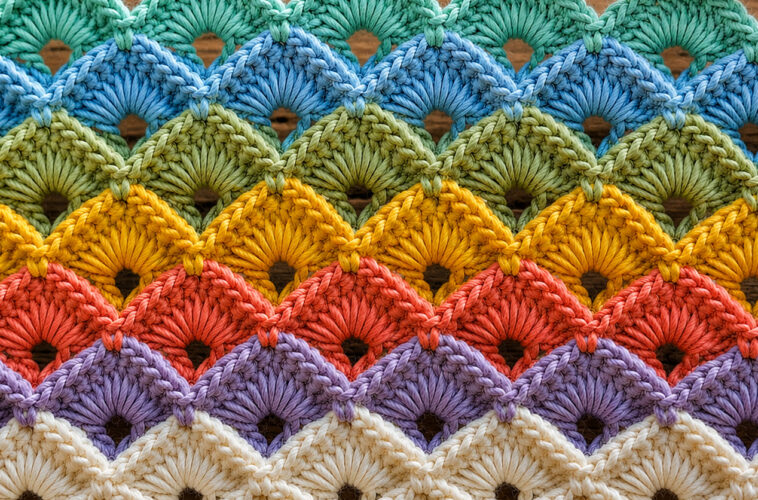
The Crochet Shell Stitch is a classic crochet technique loved for its beautiful fan-shaped texture, gentle waves, and decorative scalloped appearance. It is an excellent stitch for blankets, baby blankets, scarves, shawls, wraps, cushions, and many other crochet projects.
The stitch in the photo features rows of colorful fan-shaped shells worked in alternating colors. The combination of turquoise, blue, olive green, golden yellow, coral, lavender, and cream makes the pattern especially eye-catching.
Although it looks intricate, the basic shell stitch is surprisingly beginner-friendly. The main idea is simple: work several double crochet stitches into the same stitch or space to create a fan-shaped shell, then use single crochet stitches to separate the shells.
Crochet Shell Stitch at a Glance
Stitch name: Crochet Shell Stitch
Skill level: Beginner to intermediate
Crochet terms: US terminology
Main stitches: Chain, single crochet, double crochet
Texture: Fan-shaped, raised, decorative
Best for: Blankets, baby blankets, scarves, shawls, wraps, pillows, and borders
A very common version of the shell stitch uses 5 double crochet stitches worked into the same stitch. This creates the characteristic fan shape seen in many traditional shell-stitch designs.
Materials
For a crochet swatch, you will need:
- Worsted-weight or medium-weight yarn
- Crochet hook appropriate for your yarn
- Scissors
- Yarn needle
- Measuring tape, optional
For a colorful blanket inspired by the photograph, you can use several contrasting shades. Try combinations such as:
- Aqua or turquoise
- Sky blue
- Sage or olive green
- Golden yellow
- Coral or salmon
- Lavender
- Cream or ivory
You can also make the entire project in one color for a softer, more traditional appearance.
Crochet Abbreviations
The pattern below uses standard US crochet terminology.
| Abbreviation | Meaning |
|---|---|
| ch | Chain |
| sc | Single crochet |
| dc | Double crochet |
| sk | Skip |
| st | Stitch |
| sts | Stitches |
| rep | Repeat |
| yo | Yarn over |
Shell
Shell = 5 dc worked into the same stitch or designated space.
The number of stitches used in a shell can vary between crochet patterns, but five double crochets are one of the most common versions.
Basic Crochet Shell Stitch Pattern
For an easy practice swatch, begin with a foundation chain that is a multiple of 6 + 1.
For example:
Chain 25 for a small swatch.
This gives you enough stitches to practice several shell repeats.
Row 1
- Chain 25.
- Single crochet in the 2nd chain from the hook.
- Skip the next 2 chains.
- Work 5 double crochet stitches into the next chain.
- Skip the next 2 chains.
- Work 1 single crochet into the next chain.
- Repeat across the foundation chain:
sk 2, 5 dc in next st, sk 2, sc in next st
Continue until you reach the end of the row.
You should now see your first row of beautiful fan-shaped shells.

Row 2
Chain 3 and turn.
The turning chain may count as a double crochet depending on the specific version of the pattern. For this tutorial, work:
2 dc into the same stitch at the beginning of the row.
Then:
- Skip the next 2 stitches.
- Work 1 sc into the next stitch.
- Skip the next 2 stitches.
- Work 5 dc into the next stitch.
- Repeat across the row.
At the end, work the appropriate number of double crochets into the final stitch so the edge remains balanced.
The important part of this row is that the new shells are positioned between the shells from the previous row.

Row 3
Chain 1 and turn.
Work 1 sc into the first stitch.
Then repeat:
sk 2 sts, 5 dc in next st, sk 2 sts, sc in next st
Continue across the row.
The shells should begin forming the familiar repeating fan pattern.

Repeat the Pattern
Continue alternating the shell rows until your fabric reaches the desired length.
For a simple two-row repeat, you can repeat the shell arrangement while making sure that the 5-dc shells sit in the spaces created by the previous row.
This creates the characteristic overlapping fan effect.
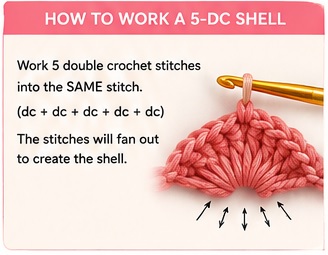
How to Crochet a 5-Double-Crochet Shell
The shell itself is very easy.
When you reach the stitch where the shell belongs:
- Yarn over.
- Insert the hook into the designated stitch.
- Yarn over and pull up a loop.
- Yarn over and pull through 2 loops.
- Yarn over and pull through the remaining 2 loops.
That is one double crochet.
Do not move to another stitch.
Instead, repeat the double crochet four more times in that exact same stitch.
You will have:
dc + dc + dc + dc + dc = 5-dc shell
The stitches spread outward naturally and create the fan shape.
Why the Shell Stitch Creates a Fan
A shell is essentially an increase because several stitches are worked into one location.
Instead of distributing five double crochets across five different stitches, all five stitches are concentrated into one stitch or space.
As those double crochets spread apart, they create the curved fan shape.
The single crochet between shells helps pull the fabric back together, creating the repeated high-and-low scalloped effect.
This is why the finished fabric has such a beautiful combination of texture and movement.
Color Changes for a Rainbow Shell Blanket
The photograph provides wonderful inspiration for a multicolored shell blanket.
You can create horizontal rows using colors such as:
Row 1: Turquoise
Row 2: Blue
Row 3: Sage green
Row 4: Golden yellow
Row 5: Coral
Row 6: Lavender
Row 7: Cream
Repeat the sequence or create your own color arrangement.
For a more polished effect, keep the same number of rows in every color.
Tip for changing colors
At the end of a row, complete the final stitch but stop before pulling through the last loops. Drop the old color and use the new color to complete the stitch.
This gives you a cleaner transition between rows.
Weave the yarn tails into the back of the project as you work rather than leaving them all until the very end.
How to Make the Shells Look Like the Photograph
If you want to recreate the colorful, layered appearance shown in the photo, consider using a slightly thicker yarn with a hook that produces a soft, flexible fabric.
The key visual elements are:
- Large 5-dc fan-shaped shells
- Alternating shell rows
- Strongly contrasting colors
- Consistent tension
- Neat edges
- Carefully positioned shells
The shells should appear to overlap visually from row to row, creating rows of arches and valleys.
For a blanket, avoid crocheting too tightly. A relaxed tension helps the shell fans open naturally and makes the finished fabric softer.
Shell Stitch Swatch
Before starting a large blanket, make a small swatch.
Try:
Foundation: ch 25
Row 1:
sc in 2nd ch from hook, *sk 2, 5 dc in next ch, sk 2, sc in next ch; rep from * across.
Row 2:
ch 3, turn; work the shell pattern across the row, placing the shells according to the spaces created by Row 1.
Row 3:
ch 1, turn; sc in first stitch, then repeat the shell sequence across.
Continue for several rows.
A swatch lets you check your stitch tension, hook size, color choices, and finished width before committing to a larger project.
Crochet Shell Stitch Blanket
The shell stitch is especially beautiful when used for blankets.
For a simple blanket:
- Choose your finished width.
- Make a foundation chain using the appropriate multiple.
- Work the shell stitch pattern across the chain.
- Continue the repeating rows until the blanket reaches your preferred length.
- Add a border if desired.
- Fasten off and weave in all ends.
For a baby blanket, pastel shades such as cream, lavender, soft blue, sage, peach, and pale yellow create a gentle look.
For a bright modern blanket, use saturated shades such as turquoise, royal blue, mustard, coral, purple, and ivory.
Shell Stitch Border
Shells also work beautifully as decorative edging.
You can add a shell border around:
- Blankets
- Baby blankets
- Shawls
- Scarves
- Pillow covers
- Dishcloths
- Crochet bags
- Table runners
A border can be worked in the same color as the project or in a contrasting shade.
For example, a cream blanket with a lavender shell border creates a delicate vintage-inspired finish.
Common Shell Stitch Mistakes
1. Putting each double crochet into a different stitch
Remember that all five double crochets of a basic shell are worked into the same stitch or space.
2. Forgetting the skipped stitches
The skipped stitches create the spaces that allow the shells to spread out.
3. Losing track of the single crochet
The single crochet separates the shells and keeps the pattern organized.
4. Making the foundation chain too tight
A tight foundation can cause the bottom edge of your blanket to pull inward.
If this happens, try using a slightly larger hook for the foundation chain.
5. Uneven tension
If some shells are much tighter than others, the fabric may look uneven.
Try to maintain consistent tension throughout the project.
How to Keep Your Shells Even
Consistent shell placement is the secret to a professional-looking result.
After completing each shell, look for the single crochet that separates it from the next shell.
When working the next row, use these stitch positions as your landmarks.
If your shell pattern suddenly begins shifting sideways, stop and count your stitches before continuing.
It is much easier to correct a mistake after one row than after ten rows.
Crochet Shell Stitch Video Tutorial
If you prefer learning visually, a video can make the shell placement much easier to understand.
This tutorial demonstrates the shell stitch using US crochet terminology and covers the foundation row and subsequent rows step by step.
You can also use this 5-double-crochet shell tutorial as a reference for understanding how the individual fan is constructed. 5 Double Crochet Shell Instructions
Frequently Asked Questions
Is the crochet shell stitch beginner-friendly?
Yes. The basic shell stitch uses familiar crochet stitches, particularly single crochet and double crochet. Once you understand how to place several double crochets into one stitch, the repeating pattern becomes easy to memorize.
How many double crochets are in a shell?
A very common shell consists of 5 double crochets worked into the same stitch. However, crochet designers can use different numbers of stitches to create smaller or larger shells.
What can I make with shell stitch?
Shell stitch is excellent for blankets, baby blankets, scarves, shawls, wraps, pillows, bags, clothing, and decorative borders.
Can I use multiple colors?
Absolutely. Shell stitch looks especially attractive when each row or group of rows is worked in a different color.
Does shell stitch use a lot of yarn?
Because multiple stitches are worked into the same location, shell stitch can use more yarn than some simple flat stitches. This is worth considering when estimating yarn requirements for a large blanket.
Can I use shell stitch for a baby blanket?
Yes. Shell stitch produces a soft, decorative fabric that works beautifully for baby blankets. Choose a washable yarn and a comfortable hook size appropriate for that yarn.
Final Thoughts
The Crochet Shell Stitch is one of those timeless patterns that looks much more complicated than it really is. Once you understand the basic rhythm of skip, shell, skip, single crochet, you can create beautiful rows of decorative fans with very little effort.
The multicolored version shown in the photo is especially inspiring. Alternating turquoise, blue, green, yellow, coral, lavender, and cream creates a cheerful blanket with a beautiful layered appearance.
Start with a small swatch to practice your shell placement and tension. Once the pattern feels comfortable, increase the foundation chain and turn it into a cozy blanket, scarf, shawl, or another handmade project.
Happy crocheting! 🧶

