 soofha
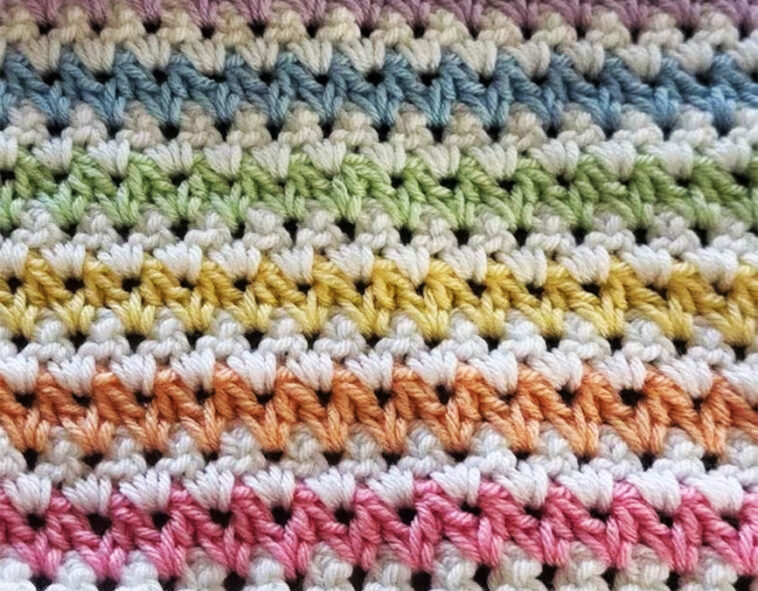
The V-Stitch Crochet Blanket is a beautiful, beginner-friendly project with a soft, open texture and a wonderfully rhythmic stitch pattern. The blanket shown here uses gentle pastel shades of sage green, dusty blue, warm beige, lavender, and white, creating a calm and cozy look that works especially well for baby blankets, throws, nurseries, and handmade gifts.
The classic V-stitch is created by working two double crochet stitches with a chain between them in the same space. When repeated across the row, the stitches form recognizable little “V” shapes. The pattern is easy to memorize, making it a relaxing project once the first few rows are established.
V-Stitch Blanket Details
- Pattern: V-Stitch Crochet Blanket
- Skill level: Easy / Beginner
- Crochet terminology: US terms
- Main stitch: V-stitch
- Texture: Light, soft, and gently open
- Construction: Worked in rows
- Color style: Alternating pastel stripes
- Best for: Baby blankets, lap blankets, throws, gifts, and cozy home décor
Materials
For a blanket similar to the one pictured, you will need:
- Worsted-weight or aran yarn
- Crochet hook suitable for your yarn, approximately 5 mm (H/8) as a starting point
- Scissors
- Yarn needle
- Measuring tape
- Stitch markers, optional
A 5 mm hook is commonly used for V-stitch blanket projects, although the best hook size depends on your yarn and the drape you want.
Suggested Color Palette
For a soft pastel blanket, try:
- White or ivory
- Sage green
- Dusty blue
- Warm beige or oatmeal
- Soft lavender
You can repeat these colors in any order or substitute your own favorite shades.
Crochet Abbreviations
Using US crochet terminology:
- ch = chain
- st/sts = stitch/stitches
- sk = skip
- dc = double crochet
- sc = single crochet
- sl st = slip stitch
What Is a V-Stitch?
A traditional V-stitch is:
(dc, ch 1, dc) in the same stitch or space.
The two double crochets create the sides of the “V,” while the chain-1 space forms the opening in the center.
This is one of the reasons the stitch works so nicely for blankets: after the foundation row, subsequent V-stitches are worked into the chain-1 spaces from the previous row.
V-Stitch Crochet Blanket Pattern
For an adjustable blanket, begin with a foundation chain that is a multiple of 3 plus 1. This gives you a simple repeat that can be adapted for different blanket sizes.
Foundation Chain
Chain a multiple of 3 + 1.
For example:
Ch 121
This produces a blanket that can be adjusted according to your preferred width, yarn weight, and hook size.
Tip: Always make a small gauge swatch before starting a large blanket if you need a specific finished measurement.
Row 1
Skip the first 2 chains from the hook.
Work:
1 dc in the next chain, ch 1, 1 dc in the same chain.
This creates your first V-stitch.
Skip the next 2 chains.
Repeat:
(dc, ch 1, dc) in the next chain, sk 2 chains
across the foundation chain.
At the end of the row, finish with a dc in the final chain.
Your first row should now have a series of open V shapes.
Row 2
Chain 3 and turn.
The chain 3 can count as your first double crochet if you prefer this method.
Work 1 dc in the first appropriate space/edge, then work:
(dc, ch 1, dc) in the ch-1 space of the next V-stitch.
Continue working one V-stitch into each V-stitch space across the row.
Finish the row with a double crochet in the final stitch or turning-chain area.
This basic row repeat is what makes the V-stitch so relaxing: once you understand where the chain spaces are, the pattern becomes highly repetitive.
Rows 3 and Beyond
Repeat Row 2 until your blanket reaches the desired length.
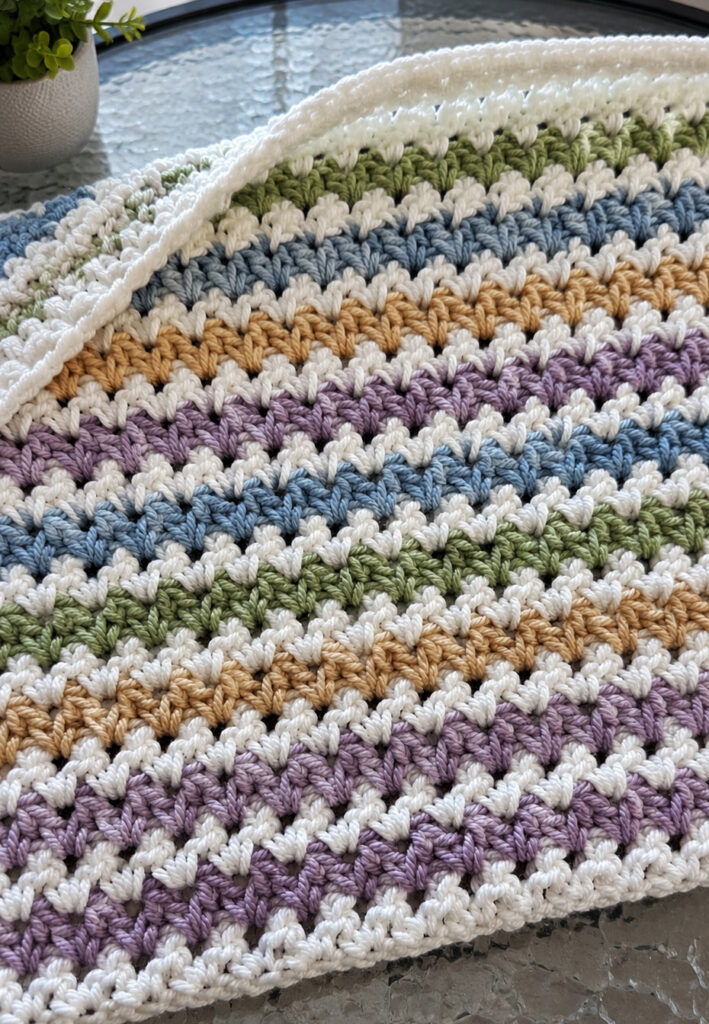
For a striped blanket like the one pictured, change colors at the end of selected rows.
A simple sequence could be:
- White
- Sage green
- White
- Dusty blue
- White
- Beige
- White
- Lavender
- White
- Dusty blue
Then repeat the sequence.
You can make the stripes narrow and delicate or work several rows of each color for broader bands.
How to Change Colors
For clean-looking stripes, complete the final double crochet of the row but stop before making the final yarn-over-and-pull-through.
Drop the old color and use the new color to complete the final pull-through.
Chain 3 with the new color and turn.
This method keeps the color transition neat and helps prevent large loops from appearing along the edge.
Creating the Blanket Border
A simple border will give the blanket a more finished appearance.
Round 1
Using white or another coordinating color, work a round of single crochet evenly around the blanket.
At each corner, work several single crochets into the same corner space so the blanket can turn smoothly without pulling.
Join with a slip stitch.
Round 2
For a simple decorative finish, continue with single crochet or use a small shell-style edging.
A delicate white border looks particularly pretty with pastel V-stitch stripes and helps frame the colors without overpowering the stitch pattern.
Adjusting the Blanket Size
One of the best features of this pattern is that it can easily be made larger or smaller.
Baby Blanket
Start with a shorter foundation chain and continue until you reach your desired length.
Lap Blanket
Use a medium-width foundation chain and work approximately 40–60 rows, depending on the yarn and hook.
Full Throw
Begin with a longer foundation chain and continue repeating the V-stitch row until the blanket reaches your preferred length.
Because yarn weight, tension, and hook size all affect the finished measurements, it is better to measure your actual work than rely only on the number of rows.
Tips for Perfect V-Stitches
1. Keep your tension consistent
V-stitch blankets look best when the tension remains fairly even throughout the project.
Avoid pulling the chain-1 spaces too tightly. These spaces help create the characteristic open V shape.
2. Work into the correct space
After the first row, the easiest way to identify where your next V-stitch belongs is to look for the chain-1 space in the center of the V.
Place both double crochets into that space.
3. Count your V-stitches
If your blanket begins to become wider or narrower unexpectedly, count your V-stitches at the end of each row.
The number should remain consistent.
4. Use stitch markers
If you are new to V-stitch crochet, place markers at both edges. This can make it much easier to identify the final stitch of each row.
5. Block the finished blanket
Blocking is optional, but it can help straighten the edges and even out the stitch pattern.
For acrylic yarn, use a method appropriate for the fiber and avoid excessive heat. For natural fibers, follow the care instructions for the specific yarn.
Why the V-Stitch Is Great for Blankets
The V-stitch is particularly useful for blankets because it has a beautiful combination of texture, simplicity, and drape.
Unlike very dense crochet stitches, the V-stitch doesn’t create an extremely heavy fabric. Its chain spaces allow the finished blanket to have some flexibility and movement.
It also works beautifully with color changes. Each row can be a different shade, or you can create large blocks of color.
The stitch is suitable for blankets, scarves, shawls, pillow covers, and other decorative projects.
V-Stitch Blanket Color Ideas
If you love the colors in the pictured blanket, here are several palettes you could try.
Soft Pastel Garden
- Ivory
- Sage
- Dusty blue
- Beige
- Lavender
Coastal Calm
- White
- Powder blue
- Seafoam
- Sand
- Pale gray
Lavender Meadow
- Cream
- Lavender
- Sage green
- Soft pink
- Light gray
Neutral V-Stitch
- Ivory
- Oatmeal
- Taupe
- Warm gray
- Cream
The beauty of this pattern is that the stitch remains attractive whether you use one color or many.
V-Stitch Blanket Pattern at a Glance
Foundation: Multiple of 3 + 1 chains
Row 1:
Skip 2 chains, (dc, ch 1, dc) in next chain, sk 2; repeat across. Finish with dc in final chain.
Row 2:
Ch 3, turn. Work (dc, ch 1, dc) into each V-stitch chain-1 space across. Finish with dc at the edge.
Repeat:
Repeat Row 2 until the blanket reaches the desired length.
Border:
Add one or more rounds of sc, or finish with a decorative edging.
Video Tutorial
If you prefer learning visually, this beginner-friendly V-stitch video demonstrates the stitch and explains how the repeating V pattern is constructed.
You can also use this V-Stitch Crochet Stitch Guide for another visual demonstration of the basic stitch:
For an additional written tutorial with diagrams and video instruction, Crochetpedia – How to Crochet V-Stitch Two Ways is a useful reference.
Final Thoughts
The V-Stitch Crochet Blanket is one of those patterns that looks more complicated than it really is. Once you understand that every V is made with two double crochets separated by a chain, the repeating pattern becomes easy to recognize.
The pastel striped version shown here is especially lovely because the white rows separate each color and make the V-stitch texture stand out. It would make a beautiful baby shower gift, nursery blanket, couch throw, or handmade keepsake.
Choose your favorite colors, make your foundation chain, and let the relaxing rhythm of the V-stitch carry you row by row. With a simple repeat and endless color possibilities, this is a crochet blanket pattern you can return to again and again.

