
 soofha
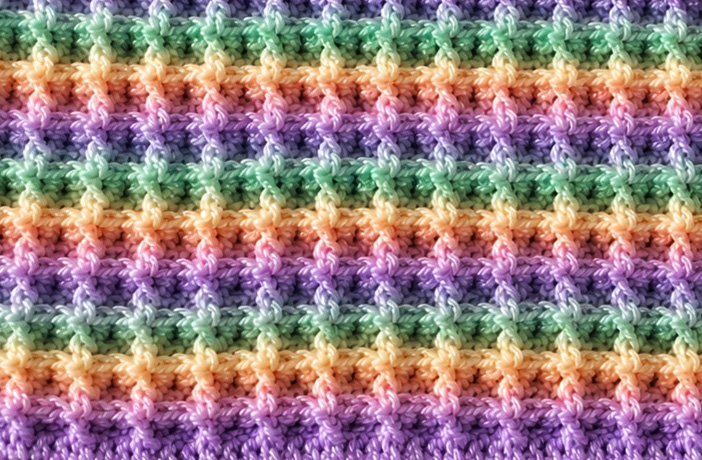
The Crochet Waffle Stitch is a beautiful textured stitch that creates a raised, cushioned surface resembling the squares of a classic waffle. It is especially lovely for blankets, throws, baby blankets, scarves, pillows, washcloths, and cozy home accessories.
The stitch in the photo has a particularly pretty look because the pastel self-striping yarn naturally changes between soft pink, lavender, mint, blue, and cream. Combined with the raised waffle texture, it creates a soft, colorful fabric that would make a wonderful handmade blanket.
The classic waffle stitch is made primarily with double crochet (DC) and front post double crochet (FPDC) stitches. The texture comes from alternating the placement of the front post stitches over a simple two-row repeat.
Crochet Waffle Stitch at a Glance
- Stitch: Waffle Stitch
- Skill level: Advanced beginner
- US crochet terminology
- Main stitches: Double Crochet and Front Post Double Crochet
- Stitch multiple: 3 + 2 chains
- Row repeat: 2 rows
- Texture: Thick, raised, and highly dimensional
- Best for: Blankets, throws, scarves, pillows, baby blankets, and home décor
- Sample hook: 4.5 mm crochet hook
The waffle stitch naturally produces a denser fabric than many basic crochet stitches because the post stitches sit prominently on the surface.
What You’ll Need
Yarn
Choose a medium-weight yarn for an easy-to-see waffle texture.
For a blanket similar to the one shown, a self-striping or gradient yarn is a great choice. Pastel yarn will emphasize the soft, dimensional appearance, while solid colors make the waffle squares particularly easy to see.
You can use:
- Worsted-weight yarn
- DK-weight yarn
- Self-striping yarn
- Gradient yarn
- Solid-color yarn
Keep in mind that the waffle stitch is already quite textured, so smooth yarn generally makes the stitch definition easier to see.
Crochet Hook
4.5 mm crochet hook
Adjust the hook size according to your yarn and desired fabric. If your finished fabric feels too stiff, try going up a hook size.
Other Supplies
- Yarn needle
- Scissors
- Measuring tape
- Stitch markers, optional
Crochet Waffle Stitch Abbreviations
These instructions use US crochet terminology.
| Abbreviation | Meaning |
|---|---|
| ch | Chain |
| st | Stitch |
| sts | Stitches |
| dc | Double crochet |
| fpdc | Front post double crochet |
| rep | Repeat |
| sk | Skip |
How to Crochet a Front Post Double Crochet
The front post double crochet (FPDC) is the most important stitch for creating the waffle texture.
Instead of inserting your hook through the top loops of the stitch, you work around the post of the double crochet from front to back and back to the front.
Step-by-step FPDC
- Yarn over.
- Insert your hook from front to back around the post of the indicated double crochet.
- Bring your hook back toward the front.
- Yarn over and pull up a loop.
- You now have three loops on your hook.
- Yarn over and pull through two loops.
- Yarn over and pull through the remaining two loops.
The completed FPDC pushes that stitch forward and creates the raised ridges characteristic of waffle stitch.
Crochet Waffle Stitch Pattern
Foundation Chain
Chain a multiple of 3 + 2.
For example:
- 20 chains
- 23 chains
- 26 chains
- 29 chains
- 32 chains
- 35 chains
Continue adding groups of three until you reach your desired width.
This multiple is commonly used for the classic flat waffle stitch pattern.
Row 1 – Double Crochet
Dc in the 3rd chain from the hook and in each chain across.
You should have a foundation row of double crochet stitches.
Turn.
Tip: Depending on the pattern version you use, the turning chain may be treated differently. For the instructions below, the turning chain is used as the turning height rather than as a counted stitch.
Row 2 – Create the First Waffle Ridges
Ch 2 and turn.
Work:
FPDC around the next stitch, dc in the next 2 stitches.
Repeat this sequence:
* FPDC, dc in next 2 sts *
across the row.
Work the appropriate final stitches at the end of the row so your stitch count remains consistent.
Turn.
This alternating combination begins forming the raised waffle squares.
Row 3 – Reverse the Pattern
Ch 2 and turn.
Work:
Dc in the next stitch, FPDC around the next 2 stitches.
Repeat:
* dc, FPDC around next 2 sts *
across the row.
Finish the row with the required double crochet stitches.
Turn.
You should now clearly see the waffle texture beginning to develop.
Row 4 and Beyond
Continue repeating Rows 2 and 3.
Easy Repeat
Row A:
FPDC, dc, dc — repeat.
Row B:
dc, FPDC, FPDC — repeat.
Continue alternating these two rows until your project reaches the desired length.
The two-row repeat is what creates the recognizable raised square pattern.
How the Waffle Texture Is Created
The secret is really quite simple.
On one row, you place the front post double crochet stitches in particular positions. On the next row, you shift them so the raised stitches sit above the previous recessed areas.
As the rows accumulate, the stitches form a series of raised horizontal and vertical ridges, producing the little square shapes that look like waffles.
This makes the stitch much easier to understand once you stop thinking of it as a complicated stitch pattern and instead think of it as:
Double crochet + strategically placed front post double crochet.
Making a Waffle Stitch Blanket
The waffle stitch is particularly well suited to blankets because it creates a wonderfully substantial fabric.
For a rectangular blanket, begin with a foundation chain that gives you the width you want, making sure the number of chains follows the required multiple of 3 + 2.
For example:
Chain 152
would work because:
150 + 2 = 152
Work the first double crochet row and then continue with the two-row waffle repeat.
Continue until the blanket reaches your desired length.
Using Self-Striping Yarn
The pastel blanket pictured is a great example of how beautiful waffle stitch can look with color-changing yarn.
A self-striping yarn can create:
- Soft horizontal color bands
- Gradual pastel transitions
- Lavender and pink waffle ridges
- Mint and blue sections
- Cream highlights
- A colorful effect without changing yarn manually
If you’re using a long-color-change yarn, let the yarn change colors naturally rather than trying to force the color changes at particular rows.
This creates a relaxed, organic appearance.
Solid-Color Waffle Stitch
The same stitch is gorgeous in one color.
Try:
- White for a clean modern blanket
- Cream for a farmhouse look
- Sage green for a botanical-inspired throw
- Dusty pink for a baby blanket
- Lavender for a soft feminine design
- Gray for a neutral home accessory
- Navy for a classic masculine-style throw
A solid color also makes the raised waffle texture especially prominent.
Waffle Stitch Border
Because the waffle stitch creates a substantial textured edge, a simple border can complement it beautifully.
After completing the blanket, you can work one or more rounds of:
- Single crochet
- Half double crochet
- Double crochet
For a clean finish, use single crochet around the entire blanket.
If your blanket edge appears slightly uneven, don’t worry. The raised texture can make the edge look different from flatter crochet stitches. Blocking can help straighten the finished piece.
Tips for Perfect Waffle Stitch
1. Count your stitches
The waffle stitch is repetitive, so losing one stitch can cause the pattern to shift.
Count your stitches at the end of each row, especially during the first few rows.
2. Learn to recognize the posts
When working an FPDC, make sure your hook goes around the post, rather than into the top of the stitch.
This is one of the most common reasons a waffle pattern doesn’t look right.
3. Keep your tension consistent
FPDC stitches can sometimes become tighter than regular DC stitches.
Try not to pull the working yarn too tightly when making the post stitches.
4. Use a smooth yarn for your first sample
A smooth yarn makes it much easier to see where your hook needs to go.
Once you’re comfortable with the stitch, experiment with fluffy, variegated, gradient, and self-striping yarns.
5. Remember that waffle stitch is thick
Because of the raised post stitches, the finished fabric can be considerably more substantial than a basic double crochet fabric. This makes it fantastic for warm blankets but something to keep in mind when choosing yarn.
Common Waffle Stitch Problems
Why doesn’t my waffle texture show?
Check your FPDC stitches.
If you accidentally work a normal double crochet into the top of a stitch instead of around its post, the raised texture won’t develop correctly.
Why is my blanket getting narrower?
You may be accidentally skipping stitches.
The waffle stitch can make it slightly harder to see the top of each stitch, so count the stitches at the end of every row.
Why are my edges uneven?
This is often related to turning chains and the first or last stitch of each row.
Mark the first and last stitch if necessary, and be consistent about whether your turning chain counts as a stitch.
Why does my fabric feel stiff?
The waffle stitch naturally produces a thick fabric. Try:
- A larger crochet hook
- A softer yarn
- Looser tension
A small swatch is the easiest way to determine whether you like the fabric before committing to a whole blanket.
What Can You Make With Crochet Waffle Stitch?
Once you’ve learned the repeat, you can use it for much more than blankets.
Crochet Waffle Stitch Blanket
The classic choice. The thick texture is perfect for cozy throws and afghans.
Baby Blanket
Choose soft pastel colors like the sample shown for a beautiful nursery blanket.
Scarf
The textured surface creates a warm and substantial winter scarf.
Pillow Cover
Use waffle stitch on the front of a cushion cover for a dimensional home décor accent.
Dishcloth
Cotton yarn works beautifully for textured kitchen cloths.
Washcloth
The raised texture gives a handmade washcloth an interesting feel.
Tote Bag
The dense fabric can work nicely for a structured crochet bag.
Afghan Squares
Create individual waffle stitch squares and join them into a larger blanket.
Waffle Stitch Video Tutorial
If you’re new to front post double crochet, watching the movement of the hook can make this stitch much easier to understand.
This tutorial demonstrates the FPDC technique and the alternating waffle stitch rows.
You can also watch a second full waffle stitch demonstration here:
Crochet Waffle Stitch Quick Reference
Foundation: Multiple of 3 + 2
Row 1:
Dc in 3rd ch from hook and across.
Row 2:
Ch 2, turn.
FPDC, dc in next 2 sts across.
Row 3:
Ch 2, turn.
Dc, FPDC in next 2 sts across.
Repeat:
Continue Rows 2–3 until desired length.
Finish:
Fasten off, weave in ends, and block if desired.
Final Thoughts
The Crochet Waffle Stitch is one of those patterns that looks much more complicated than it actually is. Once you understand how to work a front post double crochet, the repeating structure becomes easy to memorize.
Its thick, raised texture makes it especially beautiful for blankets and cozy accessories. And as the pastel sample shows, a self-striping yarn can transform the simple stitch repeat into a colorful blanket with gorgeous flowing bands of lavender, pink, mint, blue, and cream.
If you’re looking for a crochet stitch that combines texture, warmth, simplicity, and visual interest, the waffle stitch is an excellent choice.
Save this pattern for your next crochet blanket project and give the waffle stitch a try!

