

 soofha
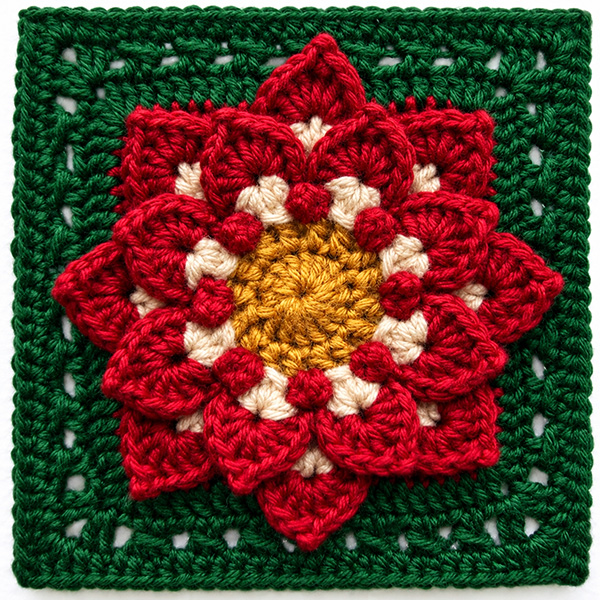
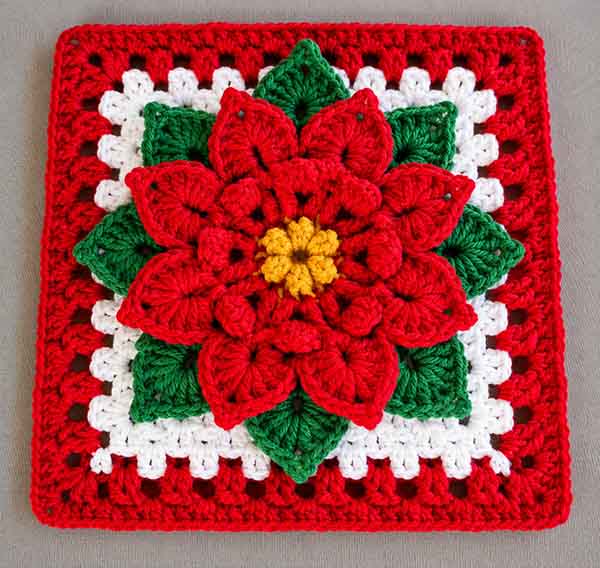
Some crochet patterns stand out because of their colors, while others catch your eye because of their texture. The Crocodile Stitch Dahlia Afghan Block has both. Its layered petals give the flower a beautiful three-dimensional look, making it a lovely choice for anyone who enjoys crocheting floral motifs with a little extra detail.
This square combines the familiar crocodile stitch with a dahlia-inspired flower. The petals curl and overlap as you work, creating a full, blooming effect in the center of the block. Once the flower is finished, you’ll crochet several rounds around it to turn the circular motif into a neat square.
Although the finished design looks intricate, the pattern becomes easier to follow when you work through it one round at a time. You’ll use basic crochet stitches alongside a few special techniques to build the petals and shape the outer edges.
Use your favorite flower color, experiment with different shades, or choose a contrasting background to make the petals stand out. A single block can be used as a decorative motif, while several matching squares can be joined together to make a striking afghan.
About the Crocodile Stitch Dahlia Block
The Crocodile Stitch Dahlia is worked in the round, beginning with a small center and gradually building outward. The first few rounds establish the flower’s center and create the loops used to form the petals. Later rounds add another layer of petals before shaping the motif into a square.
The final rounds create a structured border that makes the block easier to join with other crochet squares.
Skill level: Intermediate
Finished size: Approximately 6 × 6 inches, depending on your yarn, hook, and tension.
Construction: Worked in the round, with layered flower petals and a square outer border.
Materials You’ll Need
Gather the following supplies before you begin:
- Yarn: Worsted-weight yarn in three colors.
- Color A: Brown or black for the flower center.
- Color B: Your preferred flower color for the petals.
- Color C: Green or another contrasting shade for the square background.
- Crochet hook: US size G/6 (4.0 mm), or the size needed to achieve the desired gauge.
- Yarn needle for weaving in ends.
- Scissors.
Caron Simply Soft is one option for this project. You can also use another worsted-weight yarn that gives you good stitch definition.
Crochet Abbreviations
The pattern uses standard US crochet terminology.
- ch: chain
- sl st: slip stitch
- sc: single crochet
- hdc: half double crochet
- dc: double crochet
- tr: treble crochet
- st(s): stitch(es)
- sp: space
- BLO: back loop only
The number in parentheses at the end of a round indicates the expected stitch count or number of pattern elements.
Special Stitches and Techniques
Before starting the flower, take a moment to familiarize yourself with the following techniques.
Crocodile Stitch
The crocodile stitch creates overlapping, scale-like petals. In this pattern, each scale is formed by working double crochets around a chain loop, then adding a small chain space and single crochet to create the pointed edge.
The scales should remain slightly raised rather than being pulled tight. This gives the flower its dimensional appearance.
Banded Doubles
Work the following sequence:
- Skip the next stitch.
- Work one double crochet in each of the next two stitches.
- Yarn over and insert your hook around the two double crochets just made, in the space created beside them.
- Pull up a loop and complete the half double crochet.
This creates a small raised band that adds texture to the border.
Working Into the Side of a Stitch
When the pattern instructs you to work into the side of a stitch, insert your hook beneath both the front horizontal loop and the front vertical loop of the indicated stitch. Complete the stitch as you normally would.
This technique helps form the small loops used in the flower petals.
Turning the Work
Some rounds are worked with the wrong side facing, while others are worked with the right side facing. Follow the turning instructions carefully to keep the petals layered in the correct direction.
Gauge and Finished Measurements
Gauge is less critical for a decorative afghan block than for a fitted garment, but it will affect the finished size and how easily the squares fit together.
Using Caron Simply Soft worsted-weight yarn and a G/6 (4.0 mm) hook, aim for the first two rounds to measure approximately 2 inches across. Each crocodile scale should measure about 1 inch from its base to its tip.
The completed square should measure approximately 6 inches on each side.
If your block is noticeably larger or smaller, try adjusting your hook size or tension. If you plan to join several blocks into one blanket, keep your gauge consistent throughout the project.
Crocodile Stitch Dahlia Afghan Block Instructions
Center of the Flower
Round 1 – Color A
Begin with a magic ring or sliding circle.
Ch 3 (counts as the first dc), then work 15 dc into the circle. Join with a sl st in the top of the beginning ch-3.
Stitch count: 16 dc.
Round 2 – Color A
Ch 4 (counts as dc and ch 1). Work dc in the next dc, ch 1 around. Repeat from * to * 15 more times.
Join with a sl st in the third chain of the beginning ch-4. Fasten off.
Stitch count: 16 dc and 16 ch-1 spaces.
These first two rounds form the small center of the dahlia. Keep the center relatively flat so the petals can sit neatly around it.
First Layer of Dahlia Petals
Round 3 – Color B
Turn the work so the wrong side is facing you. Join Color B with a sc in any ch-1 space.
Ch 6, then sl st into the side of the sc just made to form a small loop.
In the next ch-1 space, work (sc, tr, sc).
Repeat the following sequence seven times:
- Sc in the next ch-1 space.
- Ch 6, then sl st into the side of the sc just made to form a loop.
- Work (sc, tr, sc) in the next ch-1 space.
Join with a sl st in the first sc.
Stitch count: 8 chain-6 loops and 8 (sc, tr, sc) groups.
The treble crochet in each group should stand out on the right side of the fabric. These raised stitches will help define the flower’s shape.
Round 4 – Color B
Ch 1 and turn so the right side faces you.
Sl st through the back loops of the next (sc, tr, sc) group.
In the next ch-6 loop, work the following to form one crocodile stitch:
- 5 dc into the loop.
- Ch 2.
- Sc into the side of the last dc.
- 5 dc into the same loop.
Sl st through the back loops of the next (sc, tr, sc) group.
Repeat this sequence around the flower, working one crocodile stitch into each remaining chain-6 loop. Join with a sl st in the beginning ch-1.
Stitch count: 8 crocodile stitches.
Gently shape each scale with your fingers. Avoid pulling the stitches too tightly, as the petals need enough room to curve and overlap.
Second Layer of Petals
Round 5 – Color B
Ch 3. Fold the next petal forward and, working behind it, sc into the Round 3 stitch at the center of that petal.
Ch 3, then sc in the sc between the next two petals.
Repeat this sequence eight times in total:
Ch 3, sc into the Round 3 stitch at the center of the next petal, ch 3, sc in the sc between the next two petals.
Join with a sl st in the first chain.
Stitch count: 16 ch-3 spaces and 16 sc.
This round creates the foundation for the next set of petals. Keep your stitches behind the first layer so the original petals remain visible.
ACCESS 20+ FREE PATTERNS HERE
Round 6 – Color B
Continue working behind the petals.
Ch 1, then sc in the same stitch.
Repeat the following sequence seven times:
- Ch 6, then sl st into the side of the previous sc to form a loop.
- Work 3 sc in the next ch-3 space.
- Sc in the next sc.
- Work 3 sc in the next ch-3 space.
- Sc in the next sc.
After completing these repeats, work the same sequence once more to finish the round:
Ch 6, sl st into the side of the previous sc to form a loop, 3 sc in the next ch-3 space, sc in the next sc, 3 sc in the next ch-3 space.
Join with a sl st in the beginning sc.
Stitch count: 8 chain-6 loops and 64 sc.
Take care to keep this round behind the first layer of petals. The new loops should sit between the existing scales.
Round 7 – Color B
Ch 1.
In the next ch-6 loop, work one crocodile stitch:
(5 dc, ch 2, sc into the side of the last dc, 5 dc).
Skip the next 3 sc, then sc in the next sc. Skip the following 3 sc.
Repeat this sequence around the flower until you have completed all eight crocodile stitches.
Join by working a sl st through the beginning ch-1 and into the next sc, securing the first petal in place.
Stitch count: 8 crocodile stitches and 8 sc.
Keep the petals folded upward as you work. This helps prevent the layers from getting in the way of your hook and preserves the full, blooming appearance.
Shaping the Flower Into a Square
Round 8 – Color B
Ch 3.
Fold the next petal forward and work a dc into the stitch at the center of that petal.
Ch 3, then sc in the stitch between the next two petals.
Repeat the following sequence four times:
Ch 3, dc in the center stitch of the next petal, ch 3, sc in the stitch between the next two petals, ch 3, sc in the center stitch of the next petal, ch 3, sc in the stitch between the next two petals.
Join with a sl st in the beginning chain.
This round establishes the four corners and four sides of the square. Make sure the central double crochet positions are evenly spaced so the finished block sits flat.
Round 9 – Color B
Ch 1.
Work the following sequence four times:
- In the next ch-3 space, work (sc, 2 hdc, 2 dc).
- Ch 2.
- In the next ch-3 space, work (2 dc, 2 hdc, sc).
- Sc in the next sc.
- Work 3 sc in the next ch-3 space.
- Skip the next sc.
- Work 3 sc in the next ch-3 space.
- Sc in the next sc.
Join with a sl st in the beginning ch-1. Fasten off.
Stitch count: 18 stitches along each side, with a ch-2 space at each corner.
At this stage, the flower should be surrounded by a more defined square outline. If the center looks slightly raised, gently arrange the petals before moving on.
Adding the Background Border
Round 10 – Color C
Join Color C with a dc in any corner ch-2 space.
Work (dc, ch 2, 2 dc) in the same corner space.
Dc in each of the next 18 stitches.
Repeat the following sequence three times:
- Work (2 dc, ch 2, 2 dc) in the next corner ch-2 space.
- Dc in each of the next 18 stitches.
Join with a sl st in the beginning dc.
Stitch count: 22 stitches along each side, with a ch-2 space at each corner.
The background color frames the dahlia and helps the individual petals stand out. Choose a shade that contrasts with the flower without overpowering it.
ACCESS 20+ FREE PATTERNS HERE
Round 11 – Color C
Sl st in the next dc, then sl st in the corner ch-2 space.
Ch 3 (counts as the first dc), then work (dc, ch 2, 2 dc) in the same corner space.
Ch 1.
Repeat the following Banded Doubles sequence seven times:
- Skip the next stitch.
- Dc in each of the next 2 stitches.
- Work a hdc around the two dc just made.
Repeat the following sequence three times to complete the remaining sides:
- Skip the next dc.
- In the next corner ch-2 space, work (2 dc, ch 2, 2 dc).
- Ch 1.
- Repeat the Banded Doubles sequence seven times.
Join with a sl st in the top of the beginning ch-3.
Stitch count: 26 stitches along each side, with a ch-2 space at each corner.
Work the raised bands loosely enough to keep the edges flexible. Consistent tension will help the square maintain its shape.
Round 12 – Color C
Sl st in the next dc, then sl st in the corner ch-2 space.
Ch 2, then work (hdc, ch 2, 2 hdc) in the same corner space.
Hdc in each of the next 26 stitches.
Repeat the following sequence three times:
- Work (2 hdc, ch 2, 2 hdc) in the next corner ch-2 space.
- Hdc in each of the next 26 stitches.
After the third repeat, hdc in each of the remaining 26 stitches along the final side.
Join with a sl st in the top of the beginning ch-2. Fasten off and weave in all loose ends.
Stitch count: 30 stitches along each side, with a ch-2 space at each corner.
Your Crocodile Stitch Dahlia Afghan Block is now complete.
Crocodile Stitch Dahlia Afghan Block Pattern
Finishing Your Dahlia Afghan Block
A little finishing work makes a noticeable difference with this pattern.
Gently tug and shape each petal so that the scales open and lie evenly around the center. Arrange the layers to give the flower a full, dimensional appearance.
Lay the square on a flat surface and check that all four corners are clearly defined. If necessary, lightly block the outer edges according to the care instructions for your yarn. Avoid flattening the raised petals, since their texture is one of the most attractive features of this design.
Weave in any remaining yarn ends securely on the back of the block.
Ideas for Using Your Finished Block
The Crocodile Stitch Dahlia square is a lovely way to add texture and color to handmade projects. Here are a few ways to use it:
- Afghan or throw: Crochet several blocks and join them to make a floral blanket.
- Cushion cover: Use one or more squares to create a decorative pillow.
- Wall hanging: Display a finished block as a small piece of textured crochet art.
- Gift project: Make a special handmade piece for someone who appreciates detailed crochet work.
- Color experiments: Try different petal and background combinations to create a coordinated set of blocks.
If you plan to make a larger blanket, crochet one complete block first and use it as your reference for the remaining squares. Matching the finished dimensions will make joining the blocks much easier.
Frequently Asked Questions
Is the Crocodile Stitch Dahlia Afghan Block suitable for beginners?
This pattern is best suited to intermediate crocheters because it involves layered petals, crocodile stitches, working behind previous rounds, and shaping a circular motif into a square. Beginners who are comfortable with basic crochet stitches may also enjoy it if they take their time.
What yarn works best for this pattern?
Worsted-weight yarn with good stitch definition is a practical choice. Caron Simply Soft is one option, but other yarns of a similar weight can also work. Choose a hook that produces a firm but flexible fabric.
Can I use different colors for the flower?
Absolutely. The original color arrangement uses a dark center, a contrasting petal color, and a background shade. You can use soft pastels for a delicate look, bright colors for a cheerful flower, or tonal shades for a more subtle design.
Why are my crocodile stitch petals curling?
Some curling is normal because the crocodile stitch is designed to create raised, overlapping scales. If the petals curl excessively, check your tension and make sure the chain loops are not too tight. Gently shape the petals after finishing.
How do I keep my afghan blocks the same size?
Use the same yarn, hook size, and tension for every block. Measure each finished square before joining it to the others. If your blocks vary slightly, gentle blocking may help even out the edges.
Can I join several dahlia blocks into a blanket?
Yes. Once you have completed enough squares, arrange them in your preferred color pattern and join them using your favorite crochet joining method. A simple join often works well because the flower centers already provide plenty of texture.
Final Thoughts
The Crocodile Stitch Dahlia Afghan Block is a beautiful project for crocheters who enjoy combining texture with floral designs. The layered petals give the flower depth, while the surrounding square makes it practical for blankets and other home accessories.
Take your time with the petal rounds, especially when working behind the first layer. Once you get into the rhythm of the pattern, watching the dahlia take shape is part of the fun.
Choose colors you love, enjoy the process, and have fun turning this textured flower into something special.

