

 soofha
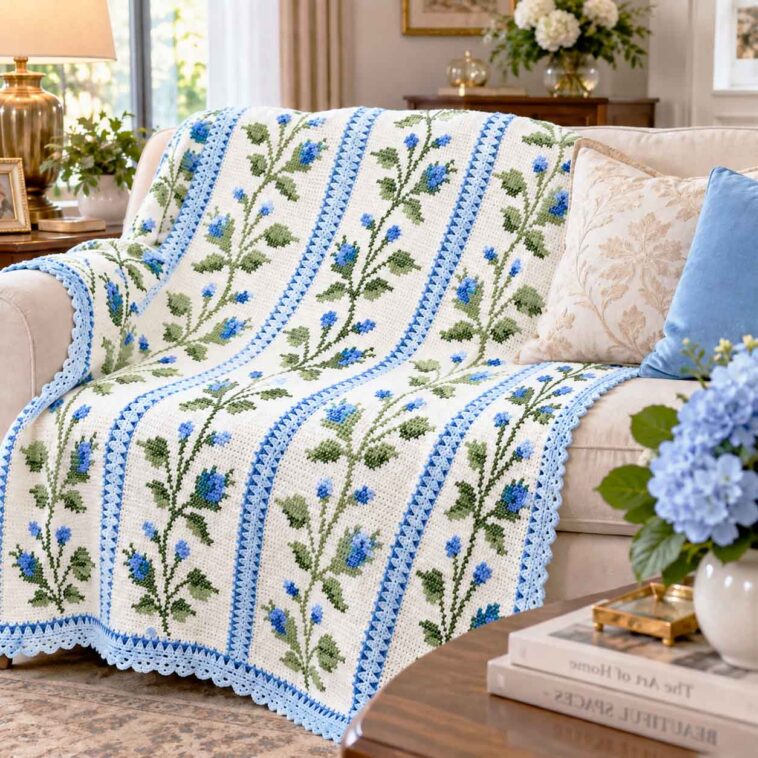
If you love floral crochet patterns, the Summer Rose Afghan is one of those projects that is hard to forget. It combines the texture of Tunisian crochet with delicate cross-stitch embroidery to create a blanket covered in climbing roses, leafy stems, and little buds.
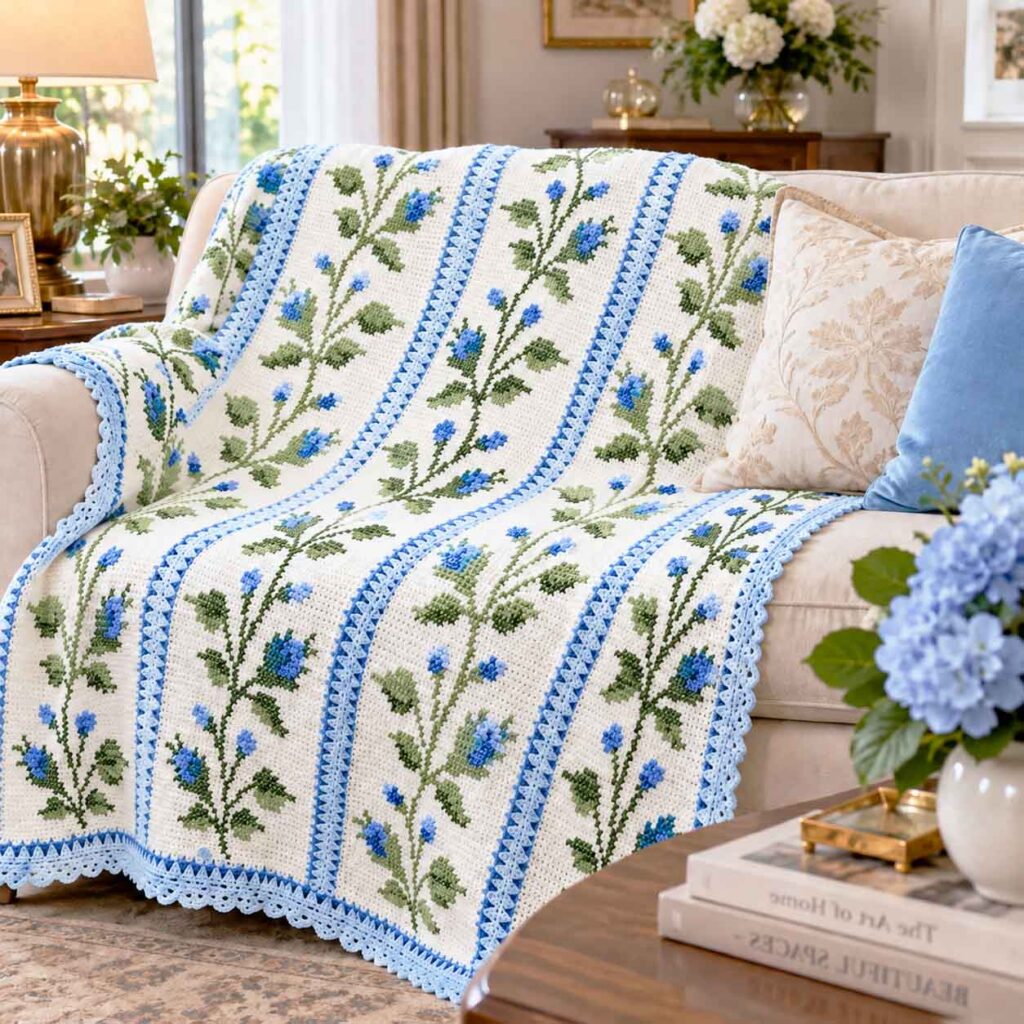
The finished afghan has a lovely vintage feel. The antique white background keeps the blanket soft and light, while the shades of pink and green bring the floral design to life. I especially love the way the roses seem to travel across the long panels rather than sitting in one fixed section. It gives the whole blanket a sense of movement, almost like a garden growing across the fabric.
This is a good project for anyone who enjoys crochet patterns with a little extra detail. The finished design looks complicated at first glance, but the afghan is actually worked in four separate panels. Once the panels are completed, the floral designs are added with cross-stitches, the individual borders are worked, and everything is joined together.
And don’t worry—you don’t have to keep track of everything from this article alone. The free Summer Rose Afghan PDF includes the complete instructions, color charts, and assembly information.
Finished Size
The completed Summer Rose Afghan measures approximately:
48 × 61 inches (122 × 155 cm)
That’s a generous size for a decorative throw on the sofa, the end of a bed, or a cozy blanket to keep nearby during cooler evenings.
Materials You Will Need
The original color combination uses an antique white background with several shades of pink and green.
For the project, you’ll need:
- Antique White yarn for the main panels
- Blush Heather yarn
- Dark Rose Heather yarn
- Rose Heather yarn
- Dusty Green yarn
- Olive yarn
- Size J (6 mm) afghan or Tunisian crochet hook
- Size H (5 mm) crochet hook
- Large-eyed blunt yarn needle
The original design uses yarns including Lion Brand Pound of Love, Wool-Ease, and Vanna’s Choice. If you can’t find the exact yarns, you can substitute yarn with a similar weight and feel.
As always, I recommend making a small gauge swatch before starting the blanket. It takes a little extra time, but it can save you from discovering halfway through the project that your finished afghan is a different size than expected.
Gauge
For the Tunisian crochet portion:
17 stitches and 15 rows = 4 inches (10 cm)
Gauge is especially important for this particular project because the floral embroidery is worked according to charts. If your stitches are significantly larger or smaller than the recommended gauge, the finished panels may not have the correct dimensions, and the embroidered design may not line up properly.
How the Afghan Is Made
The Summer Rose Afghan is made from four long Tunisian crochet panels.
Each panel is worked in Antique White. Two of the panels use Chart A for the floral embroidery, while the other two use Chart B.
The panels are arranged in an alternating order:
Panel A – Panel B – Panel A – Panel B
Once everything is joined, a final decorative border is worked around the outside of the entire blanket.
I really like this construction because you’re never trying to manage one enormous piece of Tunisian crochet. Working four narrower panels makes the project much easier to handle, especially as the blanket gets longer.
Crocheting the Four Panels
Each of the four panels begins with a foundation chain of 38 stitches and is worked for 203 rows in Tunisian stitch.
Because the panels are long and narrow, keeping your tension even is important. Tunisian crochet can sometimes curl, particularly while you’re working the piece, so don’t be concerned if the panel doesn’t look perfectly flat at first.
Try to keep your tension relaxed rather than pulling each stitch tightly. Blocking the panels after crocheting can also make a big difference before you begin the embroidery.
Adding the Rose Embroidery
This is where the Summer Rose Afghan really starts to come alive.
The roses, leaves, and other floral details are added over the finished Tunisian crochet using cross-stitches. The vertical bars created by Tunisian crochet give you a natural grid to follow, so each square on the chart corresponds to a stitch on the fabric.
Two panels are embroidered using Chart A, and the other two use Chart B.
Take your time with the charts. Floral designs can contain quite a few color changes, and it’s much easier to correct a counting mistake early than after you’ve embroidered several rows.
The color key will show you where to use each shade of pink and green. When positioning the design, count carefully from the edge of the panel and pay attention to the row-end stitch.
A large-eyed blunt needle works well for adding the cross-stitches. Try not to pull the embroidery yarn too tightly. The stitches should sit neatly on the surface of the crochet without puckering or pulling the fabric out of shape.
If you notice the panel beginning to wrinkle around the embroidery, your stitches are probably a little too tight.
Adding the Border to Each Panel
Before the four panels are joined, each one is given its own three-round border.
The border combines several basic stitches, including:
- Chain spaces
- Single crochet
- Half double crochet
- Double crochet
The Antique White and Rose Heather rounds give each panel a finished look while also creating a clean edge for joining.
Pay particular attention to the corners. Try to keep your stitch placement consistent along both the long sides and the ends of the panels. Uneven spacing can cause the edges to ruffle or pull inward.
This is one of those parts of the project where slowing down a little really pays off.
Joining the Afghan Panels
Once all four panels have been crocheted, embroidered, and bordered, it’s time to put the blanket together.
Lay the panels out on a large, flat surface first. Arrange them in this order:
Panel A – Panel B – Panel A – Panel B
Before joining anything, check the direction of the floral motifs. Make sure all the roses and leaves are facing the same way and that the top and bottom of each panel are correctly positioned.
Using Antique White yarn and the smaller 5 mm crochet hook, join the panels along their bordered edges.
Take a moment to check the seams as you go. You want the panels to lie flat without one side being stretched more than the other.
The Final Border
After all four panels have been joined, the whole afghan receives its final border.
This is a particularly pretty part of the design. The finishing rounds include chain spaces, picots, double crochet stitches, and puff stitches, creating a delicate edge around the floral blanket.
The border gives the afghan that finished, heirloom-style appearance and helps frame all of the embroidery in the center.
Once the final round is complete, fasten off and weave in all the loose ends. A little light blocking at this stage can help straighten the seams and open up the decorative border.
Tips for Making the Summer Rose Afghan
The embroidery is probably the part of this project where you’ll want to take your time. Here are a few things that can make the process easier.
Keep your colors organized.
Separate your embroidery yarn before you begin. Having each shade ready to grab makes following the chart much less frustrating.
Mark your chart as you work.
If you’re working from a printed chart, use a pencil or row marker to keep track of where you are. It’s a simple trick, but it can save you from losing your place.
Check the panel arrangement before joining.
Don’t rush straight into the seams. Lay all four finished pieces on the floor or another large flat surface and check the complete design first.
Watch your embroidery tension.
The cross-stitches should lie comfortably over the Tunisian stitches. Pulling too tightly can cause puckering.
Block before the final finishing steps.
If your panels have curled or the edges aren’t perfectly straight, blocking can help considerably before you join everything together.
Changing the Colors
The original pink-and-green color combination has a beautiful traditional look, but there’s no reason you have to stick with it.
You could try deep burgundy roses for a richer vintage appearance, or use peach, lavender, dusty blue, or soft yellow for something completely different.
When choosing your colors, think about contrast. The flowers need to stand out clearly against the background, while the leaves should be different enough from the roses to remain easy to see.
You could even choose colors based on the room where you plan to use the finished blanket.
Download the Free Summer Rose Afghan Pattern PDF
The Summer Rose Afghan is a project that combines several techniques in one beautiful blanket. You get the texture of Tunisian crochet, the detail of cross-stitch embroidery, the structure of panel construction, and a decorative crochet border all in the same project.
The climbing roses and leafy branches give it a timeless garden-inspired appearance, while the antique white background keeps the overall design soft and elegant.
For the complete pattern, including the written instructions, materials, special stitch information, color charts, assembly diagram, and finishing instructions, download the free PDF below.
Summer Rose Afghan PDF
[Download the Free Summer Rose Afghan Pattern PDF]
Once you have the basic design worked out, there is also plenty of room to make it your own. Change the rose colors, experiment with the greens, or choose a completely different palette to coordinate with your home.
Because this project brings together several different crochet and embroidery techniques, it can also be a satisfying project if you’re looking to expand your skills. And when it’s finally finished, you’ll have more than just a blanket—you’ll have a handmade piece filled with tiny details that took time and care to create.
The finished Summer Rose Afghan would make a thoughtful handmade gift for a wedding, anniversary, housewarming, or any other occasion where you want to give something personal and lasting.

