

 soofha
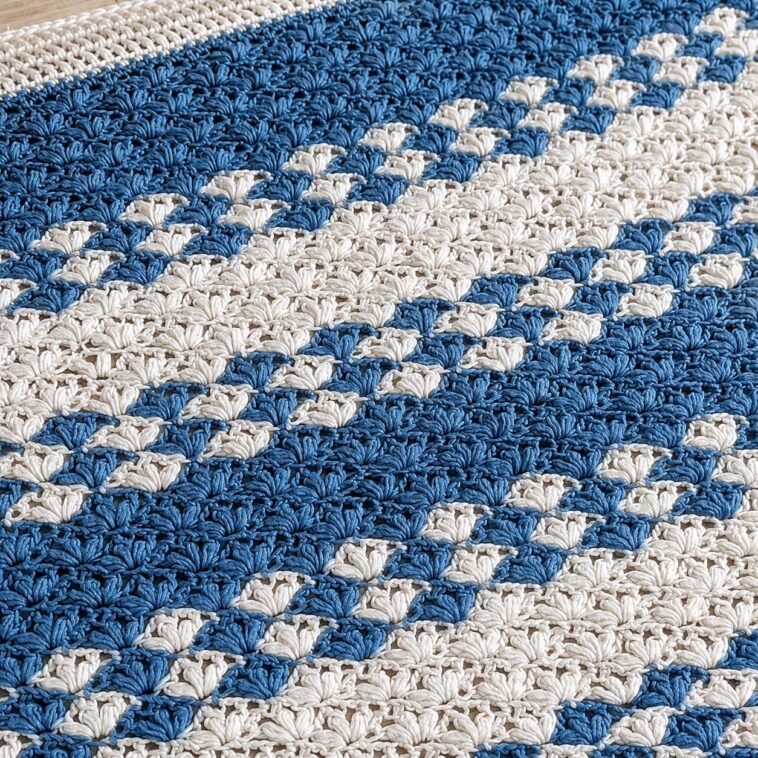
The Lotus Crochet Stitch is a beautiful textured stitch that creates rows of soft, rounded flower-like clusters. Its layered appearance resembles blooming lotus petals, making it especially lovely for blankets, scarves, baby projects, cushions, and cozy home décor.
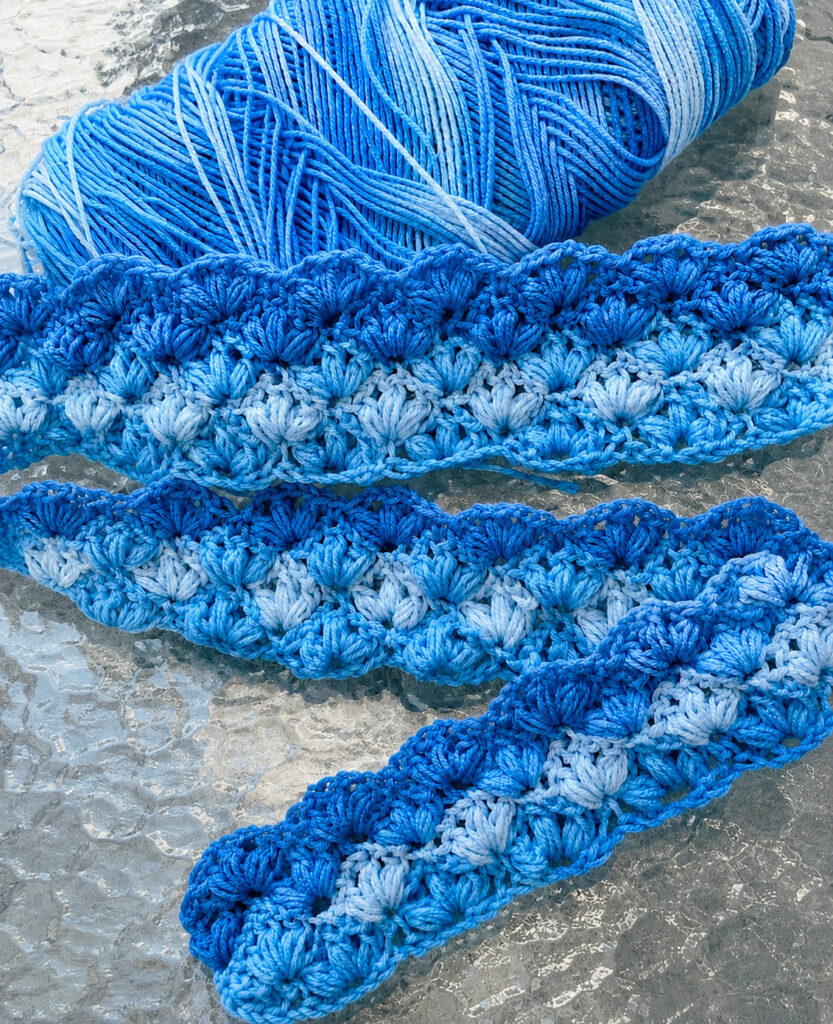
The stitch in the photo has a gorgeous combination of deep blue, bright blue, and pale blue, which really brings out the dimensional texture. The raised clusters look almost like little flowers growing across the fabric.
Lotus Crochet Stitch – Free Tutorial
This stitch is perfect if you want a crochet fabric that looks intricate without requiring complicated shaping. Once you understand how the clusters are formed, the pattern becomes quite rhythmic.
Materials
- Medium-weight yarn (#4 worsted) or your preferred yarn
- Crochet hook suitable for your yarn
- Scissors
- Yarn needle
- Measuring tape, optional
For a look similar to the sample, try using:
- Dark royal blue
- Medium blue
- Light blue
You can also make the entire stitch in one color for a more subtle floral texture.
Crochet Abbreviations
US crochet terminology:
- ch – chain
- sc – single crochet
- hdc – half double crochet
- dc – double crochet
- sl st – slip stitch
- st/sts – stitch/stitches
- sk – skip
- rep – repeat
- yo – yarn over
How the Lotus Stitch Is Built
The characteristic appearance comes from working groups of stitches together to form raised petal-like clusters. The following row then settles the clusters into the spaces between the previous ones.
For a neat result, keep your tension relaxed when pulling up the loops. If the loops are too tight, the flower clusters will not open properly.
Step 1: Make the Foundation Chain
Begin with a foundation chain in multiples of 4 + 1.
For example:
ch 25
This gives you 24 stitches for the repeating pattern plus 1 extra chain.
You can make the foundation as wide as you want:
- Small sample: 25 chains
- Baby blanket: approximately 101 chains
- Larger blanket: approximately 161 chains
The exact number will depend on the yarn, hook, and desired finished size.
Step 2: First Row
Work 1 sc in the second chain from the hook.
Continue working 1 sc into each chain across.
At the end of the row, you should have a simple foundation row of single crochet stitches.
Row 1:
Ch 1, sc in each stitch across. Turn.
Step 3: Creating the First Lotus Petals
Now we begin creating the textured portion.
The basic idea is to work several elongated loops into the same area and then close them together.
Start with the first stitch or designated space and work the beginning of your cluster.
A useful technique is:
- Insert the hook.
- Yarn over.
- Pull up a loop.
- Repeat in the same area.
- Keep the loops approximately the same height.
- Once the required loops are gathered, yarn over and pull through them to close the cluster.
This creates the rounded, petal-like shape characteristic of the Lotus Stitch.
After completing one cluster, work the small connecting section and begin the next cluster.
Continue repeating the sequence across the row.
Step 4: The Second Row
The next row helps define the individual lotus flowers.
Work your stitches into the spaces created between the clusters rather than directly through the thickest part of each flower.
This allows the clusters to remain raised while the background stitches create the valleys between the petals.
Continue across the row, maintaining an even stitch count.
At the end:
Turn your work.
Step 5: Repeat the Pattern
The beauty of this stitch is that the same basic two-row structure can be repeated.
Your fabric will gradually develop rows of rounded floral motifs.
A typical sequence is:
Row A: Create the lotus/petal clusters.
Row B: Work into the spaces between the clusters.
Repeat these rows until your project reaches the desired length.
As you continue, you’ll notice that the flowers begin to line up in attractive horizontal rows.
Changing Colors
The Lotus Crochet Stitch looks particularly beautiful when worked in multiple colors.
The sample shown uses a stunning blue palette, but you can choose practically any combination.
Blue Lotus
Try:
- Navy
- Royal blue
- Sky blue
- Pale blue
Soft Floral
Try:
- Cream
- Blush pink
- Dusty rose
- Lavender
Garden Colors
Try:
- Sage green
- Soft yellow
- Peach
- Cream
Classic Neutral
Try:
- White
- Beige
- Taupe
- Warm gray
For the cleanest color changes, change yarn at the end of a row. This creates clear horizontal bands and makes each row of lotus flowers stand out.
Lotus Stitch Blanket
This stitch would make an especially beautiful crochet blanket because the raised clusters create a soft, tactile surface.
For a baby blanket, a finished size around 30 × 36 inches is a comfortable starting point.
For a larger throw, you could aim for approximately 50 × 60 inches.
Because crochet tension varies from person to person, always make a small swatch before calculating the exact number of foundation chains.
Simple Blanket Plan
You could create a striped blanket like this:
- 4 rows dark blue
- 4 rows medium blue
- 4 rows light blue
- 4 rows pale blue
- Repeat
Alternatively, use one color for every lotus flower and another color for the background.
Tips for Perfect Lotus Crochet Stitches
1. Keep your loops even
When making the raised clusters, try to pull each loop to approximately the same height.
Uneven loops can make some flowers appear larger than others.
2. Don’t crochet too tightly
This is particularly important with textured stitches.
A tight tension can make the clusters stiff and compressed.
3. Use a smooth yarn
For your first attempt, choose yarn with good stitch definition.
Cotton, acrylic, or a cotton-acrylic blend can work beautifully.
Very fuzzy yarn can hide the individual petals.
4. Practice with a small swatch
Before starting a blanket, make a small sample.
This gives you an opportunity to check:
- Stitch definition
- Yarn tension
- Hook size
- Color combinations
- Finished width
5. Count your stitches
Textured stitches can make it difficult to see individual stitches.
Counting at the end of each row will help keep your project straight.
What Can You Make With the Lotus Stitch?
Once you become comfortable with this stitch, there are many possibilities.
🧶 Blankets
The raised floral texture makes this stitch especially suitable for cozy throws and baby blankets.
🧣 Scarves
A long strip of Lotus Stitch creates a warm and decorative scarf.
🛏️ Pillow Covers
Use the stitch on the front of a cushion cover and combine it with simple crochet on the back.
👶 Baby Blankets
Choose soft pastel colors for a delicate floral effect.
👜 Bags
The dense texture can create an attractive fabric for crochet bags and purses.
🧺 Home Décor
You can also experiment with table runners, baskets, mats, and decorative panels.
How to Make the Flowers Stand Out
If you really want the lotus motifs to pop, use contrasting colors.
For example, imagine:
Row 1: Dark blue
Lotus petals: Light blue
Background: Medium blue
The contrast makes each flower much easier to see.
For a softer look, use three shades from the same color family. The blue sample demonstrates how beautiful this monochromatic approach can be.
Blocking Your Finished Piece
Blocking isn’t always necessary, but it can make a big difference with textured crochet.
After finishing your project:
- Gently wash or lightly dampen the crochet.
- Lay it flat on a clean surface.
- Shape the edges carefully.
- Make sure the rows are straight.
- Allow it to dry completely.
Avoid stretching the raised flowers excessively. You want to preserve the dimensional texture.
Lotus Crochet Stitch Troubleshooting
Why don’t my flowers look rounded?
Your loops may be too short or your tension may be too tight. Try pulling the loops slightly higher and keeping your tension relaxed.
Why is my project getting narrower?
Check your stitch count at the end of every row. Missing a stitch during a textured pattern can cause the width to decrease gradually.
Why are my clusters too loose?
Make sure you are closing the cluster securely and maintaining consistent loop height.
Can I use a different yarn weight?
Absolutely. The stitch can be adapted to different yarn weights. Simply choose a crochet hook appropriate for the yarn and make a swatch first.
Final Thoughts
The Lotus Crochet Stitch is one of those patterns that looks wonderfully complicated once finished, but becomes much easier after you understand the repeating cluster structure.
Its beautiful raised flowers give crochet projects a rich, handcrafted appearance, while color changes can completely transform the final design.
Whether you use deep blue and sky blue like the sample, soft pastels for a baby blanket, or warm neutral shades for home décor, the Lotus Stitch is a wonderful pattern to add to your crochet collection.
Save this tutorial, choose your favorite yarn colors, and give the Lotus Crochet Stitch a try! 🧶🌸💙

